Webinars
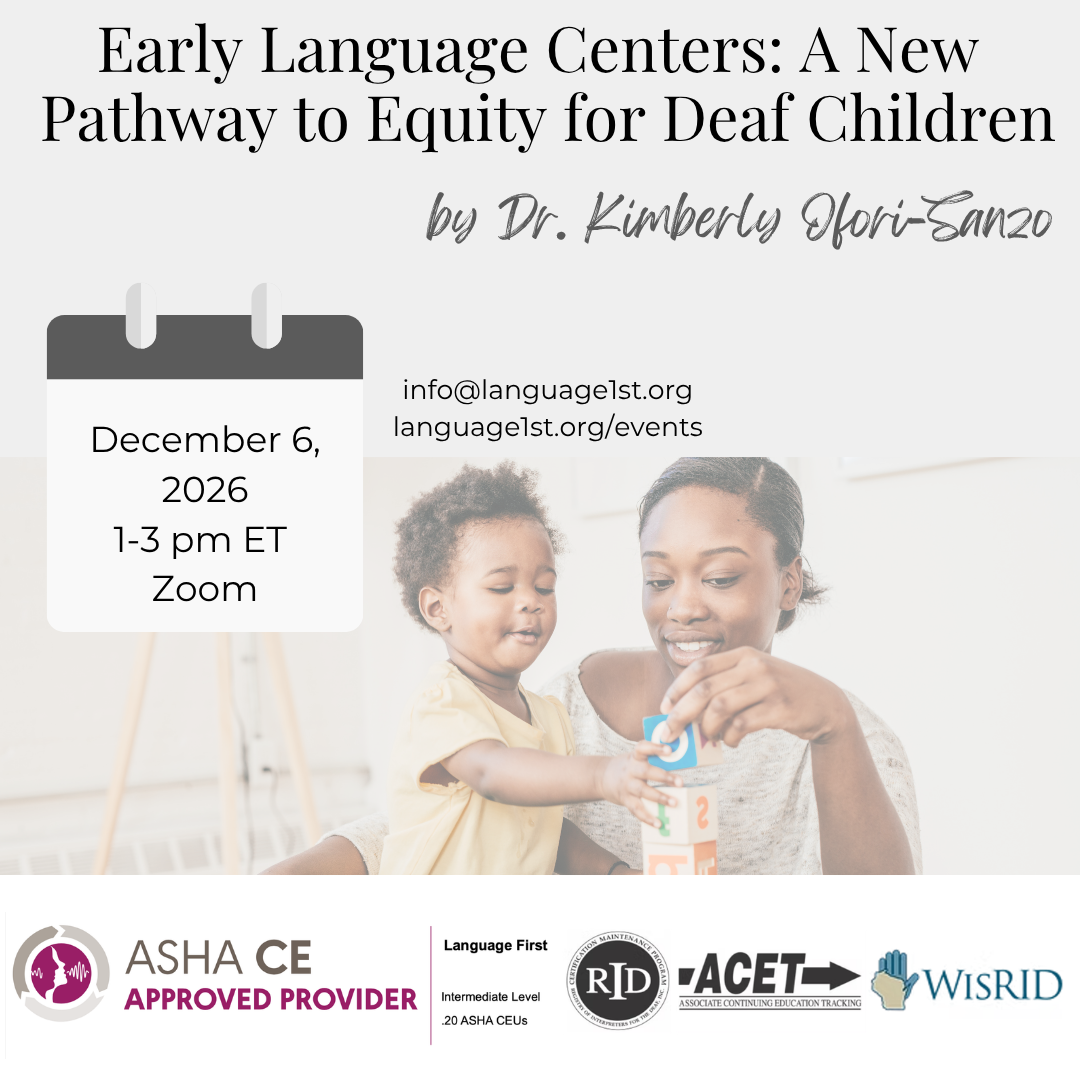
This webinar will be hosted via Zoom for national and international attendees on Sunday, December 6, 2026 from 1:00 - 3:00 pm ET.
Speaker Disclosures:
Financial disclosures: Kim is the owner of Language First and is receiving payment for presenting.
Nonfinancial disclosures: Kim is a member of ASHA, ABCLLD, and ABDHHS.
Content disclosure: This presentation will focus solely on the Language First Early Language Centers (ELCs).
Course Description:
This session introduces a scalable Early Language Center (ELC) model designed to ensure early, robust language access for Deaf and hard of hearing children through bilingual ASL–English development and intentional family involvement. Participants will explore the core components of the ELC model, including Deaf-centered practice, language-rich environments, family coaching, and coordinated services—and how this approach bridges long-standing gaps between early intervention and educational systems. We’ll share how ELCs function as both a clinical and community-based solution, offering a replicable framework that can be adapted nationwide. Language deprivation is not inevitable—it is fully preventable. This session challenges us to move from awareness to action and to reimagine what true language equity can look like for Deaf children and their families.
Agenda
1:00-1:30: Early Language Environments (ELEs)
1:30-2:00: ELEs for DHH Children
2:00-2:40: Early Language Centers (ELCs)
2:40-2:45: Future Directions
2:45-3:00: Q&A and discussion
Learner Outcomes:
Participants will be able to:
Define the core components of the Early Language Center (ELC) model
Explain how Deaf-centered, bilingual ASL–English environments support early brain and language development
Apply key principles of the ELC framework to their own setting
Registration information:
This is a digital purchase only; no physical ticket is provided. A form will populate for you to complete your registration and then your purchase will be added to your cart in the upper right-hand corner of the screen. You will receive an email with instructions on how to participate as well as a Google Calendar invite with the Zoom link one week prior to the event. Registration ends one day prior to the webinar. All registrants will receive a copy of the presenter’s PowerPoint and the presentation recording. Please email info@language1st.org with any questions.
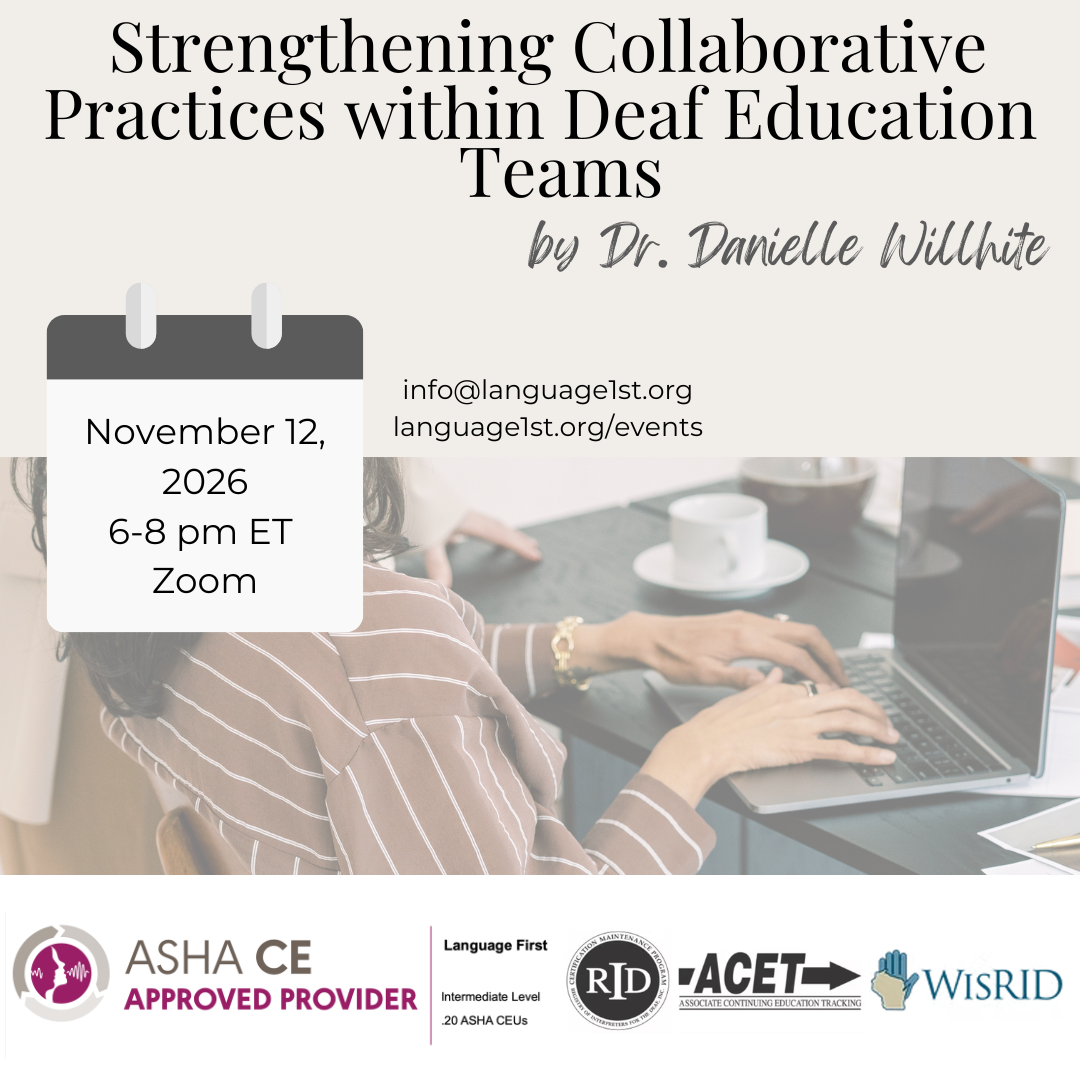
This webinar will be hosted via Zoom for national and international attendees on Thursday, November 12, 2026 from 6:00 - 8:00 pm ET.
Speaker Disclosures:
Financial disclosures: Dr. Willhite is receiving an honorarium from Language First for presenting.
Nonfinancial disclosures: Dr. Willhite serves as the Board President of the Convention of American Instructors for the Deaf (CAID). She is the founder of the Facebook group DeafEd Collaborative, where she promotes her educational consultation services for school districts. She is also the founder and administrator of the Facebook group Educational Interpreters and TODs Working Together.
Course Description:
Collaboration among the Deaf Education team is essential to ensuring equitable access and meaningful educational outcomes for DHH students. This presentation explores how the unique roles of each team member align to support student success and why intentional collaboration is critical. Participants will examine common barriers to effective teamwork, identify information that can and should be shared among team members, and learn practical strategies for improving communication and coordinated service delivery. Attendees will receive tools, templates, and resources that can be adapted to establish collaborative systems tailored to their own educational teams, fostering sustainable partnerships that strengthen student access, participation, and achievement.
Agenda
6:00-6:15: Introduction, presentation objectives, and why collaboration matters for Deaf and hard of hearing student outcomes
6:15-6:35: Roles and responsibilities of Teachers of the Deaf, educational interpreters, and other educational team members, including how these roles align to support student success
6:35-6:50: Common barriers to effective collaboration and strategies for overcoming communication and systems challenges
6:50-7:10: Information sharing among team members—what can be shared, when collaboration is appropriate, and establishing effective communication practices
7:10-7:45: Demonstration of practical tools, templates, and collaborative resources, including examples of how to adapt and implement them to build sustainable systems for your educational team
7:45-8:00: Q&A
Learner Outcomes:
Participants will be able to:
Compare and contrast the roles and responsibilities of Deaf Education team members and how their roles align to support DHH students
Identify at two strategies to improve collaboration and communication within your educational team
Describe how one tool, template, or resource from the workshop can be implemented or shared within your Deaf Education team to strengthen collaboration and establish effective team systems
Registration information:
This is a digital purchase only; no physical ticket is provided. A form will populate for you to complete your registration and then your purchase will be added to your cart in the upper right-hand corner of the screen. You will receive an email with instructions on how to participate as well as a Google Calendar invite with the Zoom link one week prior to the event. Registration ends one day prior to the webinar. All registrants will receive a copy of the presenter’s PowerPoint and the presentation recording. Please email info@language1st.org with any questions.
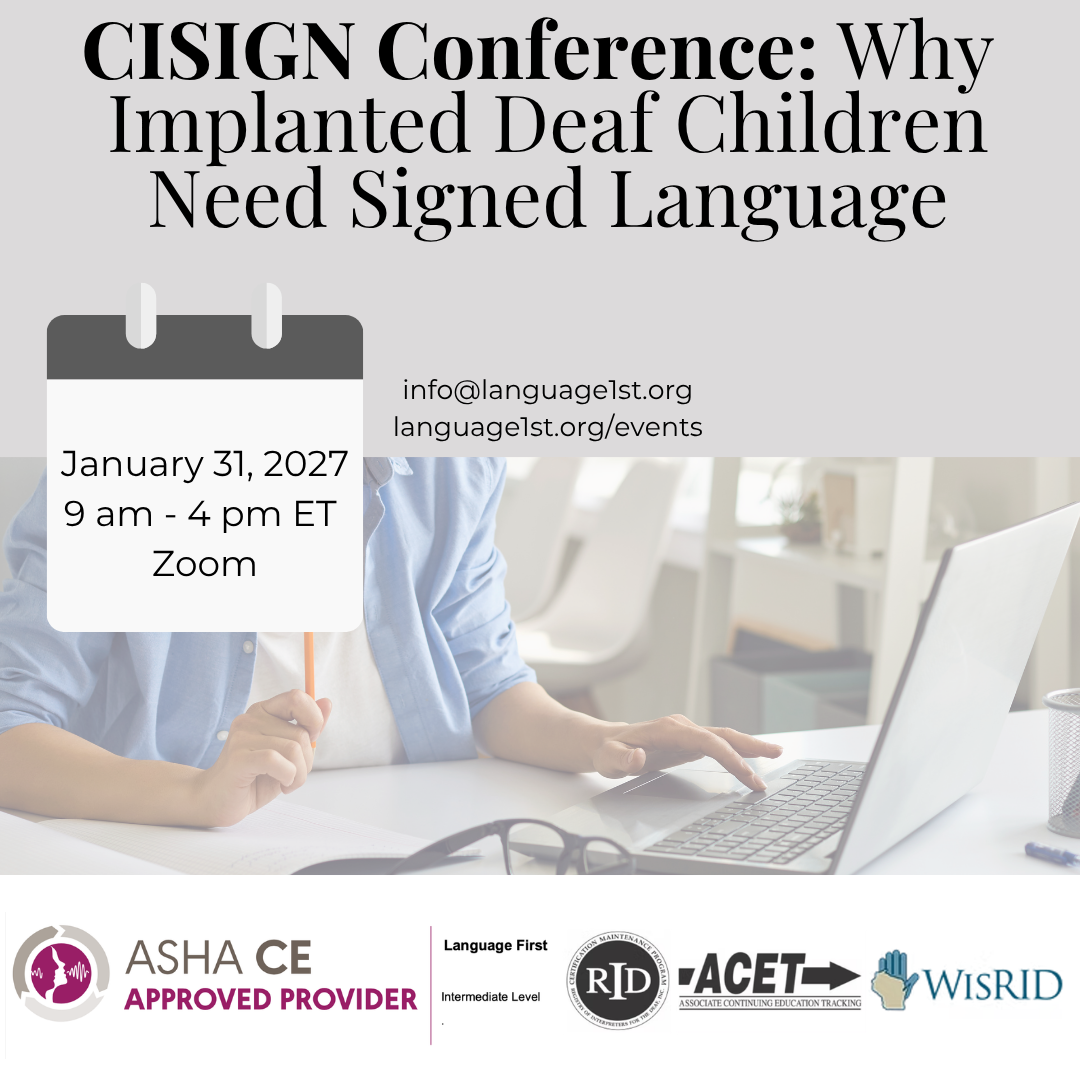
The first-ever CISIGN Conference will be held virtually, on Zoom, on January 31, 2027 from 9:00 am - 4:00 pm. Find out more about our CISIGN Campaign here.
SCHEDULE
Sunday, January 31
9-9:30 | Welcome, Introduction to the CISIGN Campaign
9:30-10:30 | Dr. Kimberly Ofori-Sanzo, Dr. Michelle Veyvoda, & Dr. Amanda Howerton-Fox, The Science of Cochlear Implants and Early Language Development
Session description: Cochlear implants have provided auditory stimulation for some deaf children, but they have not eliminated the need to ensure complete and accessible language acquisition. This presentation reviews current research on cochlear implant outcomes, variability in auditory access, language development, and brain plasticity, while examining persistent misconceptions surrounding spoken language outcomes and signed language exposure. Participants will discuss current controversies in cochlear implant counseling and intervention and consider the ethical responsibility of professionals to prioritize complete language access for every deaf child. The session concludes with practical recommendations and a call to action for clinicians, educators, and early intervention providers.
Agenda:
9:30-9:45: Current research and outcomes for cochlear implants
9:45-10:00: Language development, brain science, and neuroplasticity
10:00-10:10: Evidence for early ASL-English bilingualism
10:10-10:20: Considerations for professionals
10:20-10:30: Q&A
Learner objectives:
Participants will be able to:
Describe current research regarding language and developmental outcomes for deaf children with cochlear implants.
Explain how brain development, neuroplasticity, and sensitive periods influence language acquisition in children with cochlear implants.
Discuss the rationale for an ASL-English bimodal bilingual approach for young deaf children with cochlear implants.
Speaker disclosures: Dr. Veyvoda and Dr. Howerton-Fox are receiving honorariums from Language First for presenting. Dr. Ofori-Sanzo is the owner and founder of Language First.
11-12 pm | Dr. Sarah Sparks, When Communication Plans Aren't Enough: Developing Multimodal Communication Agility
Session description: Communication planning is a key aspect of overall educational planning for DHH students. School-based team members create individualized communication plans documenting language(s), mode(s), hearing technologies, and various tools that DHH students need throughout the school day for communication. But are these plans enough to enable robust language and communication access at school? And more importantly, in life? Why does communication planning often fail to deliver on its intended goal of consistent access, and what can we do to change that? This presentation will address these questions and propose strategies for building DHH students' multimodal communication agility.
Agenda:
11:00-11:05: Introduction
11:05-11:20: Communication Planning and Its Pitfalls, with Examples
11:20-11:40: What Is Multimodal Communication Agility? with Examples
11:40-11:50: How to Build Multimodal Communication Agility
11:50-12:00: Conclusion and Questions
Learner objectives:
Participants will be able to:
Define the term "multimodal communication agility."
Describe at least 3 pitfalls of communication planning and 3 solutions for these problems.
Apply the concept of multimodal communication agility to case examples of DHH students.
Speaker disclosures: Dr. Sparks is a full-time employee of Baltimore City Public Schools, an adjunct instructor for Gallaudet University, Boston University, A.T. Still University of Health Sciences, and Flagler College. She is the founder of Audiology Outside the Box, a member of ASHA, AAA (Accessibility Task Force Chair), and EAA (VP of Online Communications) as well as the DC Speech-Language Hearing Association (CE Administrator) and the Maryland Speech-Language Hearing Association (Director of Audiology). She is receiving an honorarium from Language First for presenting.
LUNCH
1-2 pm | Sara Miller, Listening and Signing: A Cochlear Implant User's Perspective
Session description: Cochlear implants can provide valuable access to sound, but they do not replace the need for a fully accessible first language or eliminate the value of Deaf identity and signed languages. In this session, Sara Miller (a Deaf adult cochlear implant user) will share her personal journey—from being born deaf and growing up wearing hearing aids, to choosing cochlear implantation as an adult, navigating life with a CI, and discovering the important role that ASL has played throughout her life. This session offers an opportunity to hear directly from someone who has experienced both spoken and signed language environments. By listening to this lived experience, participants will gain insight into the benefits and limitations of cochlear implants, the realities of navigating a hearing-centered world, and why access to a natural signed language remains essential regardless of hearing technology.
Agenda:
1:00-1:10: Personal background and hearing history
1:10-1:25: Life with a cochlear implant, expectations versus reality, what the implant does and does not provide
1:25-1:40: How sign language changed communication, identity, relationships, and access
1:40-1:50: What professionals and families should know, common misconceptions, advice for supporting deaf children today
1:50-2:00: Q&A
Learner objectives:
Participants will be able to:
Describe Sara’s lived experience as a cochlear implant user (both the upsides/downsides).
Explain why access to ASL can remain valuable for deaf individuals with cochlear implants.
State how lived experience can complement research evidence when making family-centered recommendations about communication and language development.
Speaker disclosures: Sara is receiving an honorarium from Language First for presenting. She has no relevant nonfinancial disclosures.
2:30-3:30 pm | Dr. Marie Coppola, Language is Central: Early Access to Signed or Spoken Language Promotes Age-Appropriate Cognitive Development
Session description: This large study of 404 deaf, hard of hearing, and hearing children (ages 3–10) tested how language modality (signed vs. spoken) and timing of language access (from birth vs. later) affect cognitive and academic development. Across nearly all measured skills—vocabulary, counting, executive function, and even nonverbal tasks—timing of access mattered far more than modality. Children exposed to language from birth, whether ASL or English, showed comparable outcomes, underscoring the need for early, fully accessible language input alongside any hearing technology.
Agenda:
2:30-2:45 Introduction, review of number development in hearing children who have full access to language from birth, study design
2:45-2:55: Results: Development of foundational number concepts in deaf, hard of hearing, and hearing children
2:55-3:05: Results: Mapping between different representations of quantity (signed/spoken words, Arabic numerals, objects)
3:05-3:10: Results: Mathematic calculation fluency
3:10-3:15: Results: “Nonlinguistic” tasks
3:15-3:30: Q&A
Learner objectives:
Participants will be able to:
Explain the evidence that timing of language access — not language modality or hearing status — predicts cognitive and academic outcomes.
Identify why cochlear implantation alone cannot guarantee timely language access, and describe the risk this poses during the candidacy-to-activation period.
Apply the study's findings to counsel families and design interventions that support bilingual (signed + spoken) language exposure from birth.
Speaker disclosures: Dr. Coppola receives a salary from the University of Connecticut. Her views on promoting early access to language are based in scientific evidence and lifelong experience in the deaf community, as a CODA.
This is a digital purchase only; no physical ticket is provided. A form will populate for you to complete your registration and then your purchase will be added to your cart in the upper right-hand corner of the screen. Please email info@language1st.org with any questions.
In Person Events
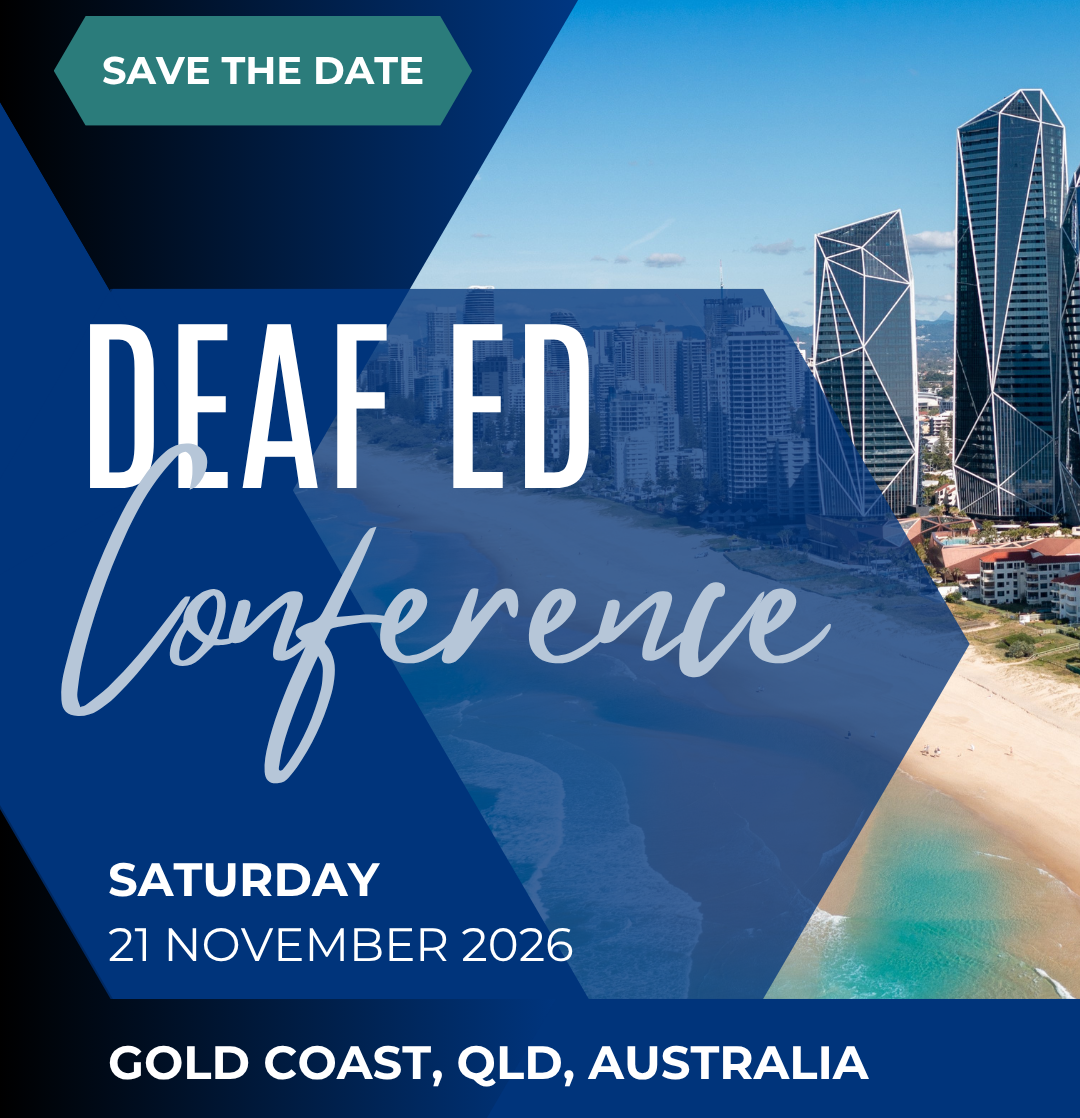
This conference will be in-person at the Broadbeach Cultural Centre in Gold Coast, QLD, Australia on November 21, 2026 from 9:00 am - 4:00 pm.
See the full schedule and session descriptions here.
ADVERTISEMENT & SPONSORSHIP
Want to exhibit in-person or support us by becoming a conference sponsor? Find out more here.
GETTING THERE
We recommend flying into Gold Coast Airport.
SCHEDULE AT-A-GLANCE
Saturday, November 21
7:00-9:00 am | Registration, coffee
8:45-9:00 | Clare Best, Welcome
9:00-10:00 | Dr Kimberly Ofori-Sanzo, Intervention and Instructional Techniques for Deaf Children
10:15-11:15 | Suzanne Robertson,Access Is Not Support: Reframing Deaf Education Through a Language First Lens
11:30-12:30 | Julia Murphy, Because of Auslan
12:30-1:30 | Lunch at the venue
1:30-2:30 | Dr Karin O'Reilly, Seeing Minds: Language Access, Brain Architecture, and the Social Lives of Deaf Children
2:45-3:45 | Dr Ramas McRae, The Association Between Early Life Access to Communication and Mental Health Outcomes Among Deaf People
4:00-5:00 | Dr Erin West, Using Data to Ensure Language Equity for Children Who Use Sign Language
5:00-5:15 | Closing, giveaways
This is a digital purchase only; no physical ticket is provided. A form will populate for you to complete your registration and then your purchase will be added to your cart in the upper right-hand corner of the screen. Please email info@language1st.org with any questions.
PLEASE NOTE: All prices are in USD. Given the current exchange rate, the price is calculated at approximately 298 AUD, though the final amount may vary slightly depending on the rate at the time of processing.
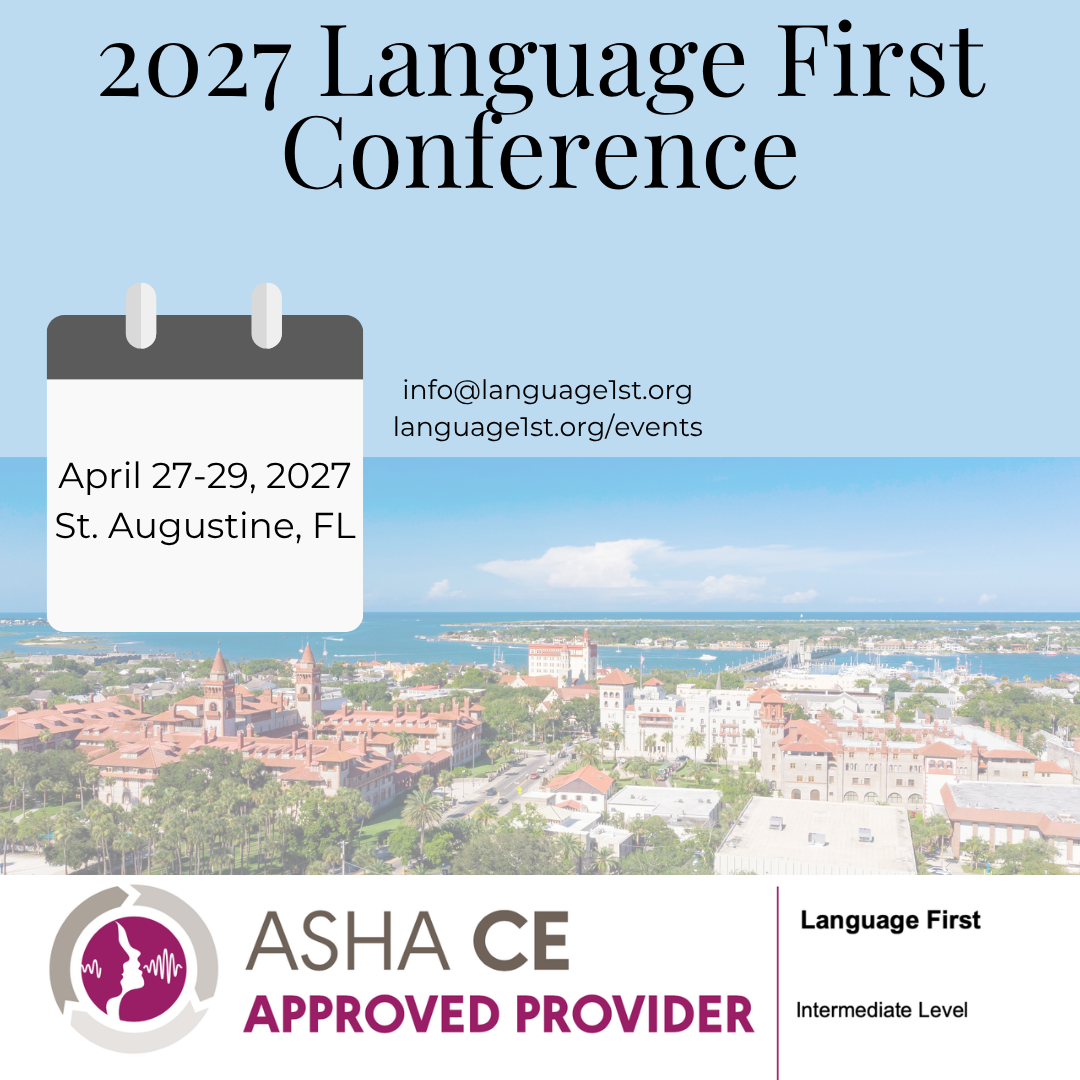
The 2027 Language First conference will be in-person at the Hyatt Place St. Augustine / Vilano Beach at 117 Vilano Road, St. Augustine, FL on April 27-29, 2027. It will be from 12:00 - 5:00 pm on Tuesday, April 27, and 8:00 am - 5:00 pm on Wednesday, April 28 and Thursday, April 29. To book a room at the hotel, use this booking link.
See full schedule and session descriptions here.
ADVERTISEMENT & SPONSORSHIP
Want to exhibit in-person or advertise your business in our conference booklet? Or perhaps you’d like to support us by becoming a conference sponsor? Find out more here.
GROUP DISCOUNTS
Does your school have a group of professionals who would like to attend the conference together? Take a look at our group discounts. Email info@language1st.org for more information.
GETTING THERE
We recommend flying into Jacksonville International Airport (JAX).
SCHEDULE AT-A-GLANCE
Tuesday, April 27
8 am - 12 pm | Registration check-in and vendor set-up
12-12:30 pm | 10th annual conference welcome and video, “The Story of the Language First Conference”
12:30-1:30 pm | Julie Kessluk & Kaycee Rebello, Beyond the Running Record: Rethinking Reading Assessment for ASL Users.
*lunch provided
1:45-2:45 pm | Dr. Deborah Chen Pichler & Dr. Diane Lillo-Martin, How Effective is Early ASL Input if it’s not “Fluent” Input?
3-4 pm | William Fertman, Read to Your Deaf Kid Because No One Else Will (with Some Exceptions)
4-5 pm | Book signing, closing, giveaways
Wednesday, April 28
8:15-9:15 am | Dr. Elaine Gale & Dr. Shane Blau, Making Early Language Work: Learning from Deaf Adults’ Visual Strategies
9:30-10:30 am | Jamila Hubbard, ASL Linguistics in the Classroom: From Language Knowledge to Teaching Practice
11 am - 12 pm | Rhys McGovern, Embedding Culture: Deaf Mentoring in the Mainstream Classroom
12-2 pm | Lunch on own
2-3 pm | Dr. Emily Jo Noschese, Using Bilingual Grammar Curriculum Assessment Data to Inform ASL-English Bilingual Instruction
3:15-4:15 pm | Dr. Brittany Lee & Dr. Kristen Secora, Social Determinants of Language Access
4:15-4:45 pm | Elisa Abenchuchan Vita, Exploring the #CommSciences Tag in the TrueWay ASL Dictionary App (optional)
4:45-5:00 pm | Closing, giveaways
7:30 pm | Accessible sunset water tour (optional add-on)
Thursday, April 29
8:15-11:15 am | Vyron Kinson, Is BASL fo' Real?
11:30 am - 12 pm | Ariel Baeseman-O'Donnell and Mary Grace Hamme, POSTERS: Deaf Education in Ethiopia; AAC Support Classes for DHH Students; Instructor Perceptions of Neurodivergence in ASL Classrooms
12-2 pm | Lunch on own
2-3 pm | Eliza Porter & Geoffrey Porter, Alternative Augmentative Communication for Hearing Parents
3:15-4:15 pm | Marissa Chappell, Reforming Outcomes Measurement for Deaf Children in Early Intervention
4:15-4:30 pm | Closing, giveaways
This is a digital purchase only; no physical ticket is provided. A form will populate for you to complete your registration and then your purchase will be added to your cart in the upper right-hand corner of the screen. Please email info@language1st.org with any questions.
Group Therapy Sessions