This webinar will be hosted via Zoom for national and international attendees on Monday, June 15, 2026 from 6:00 - 8:00 pm ET.
Speaker Disclosures:
Financial disclosures: Elisa has no relevant financial disclosures.
Nonfinancial disclosures: Elisa is an independent contractor for TRUE+WAY ASL Textbook / TWA Dictionary.
Course Description:
This presentation explores how an online ASL–English dictionary can support Deaf and Hard of Hearing (DHH) students’ language development across a variety of educational and clinical settings. Participants will first examine the rationale for using an ASL–English dictionary as a tool for strengthening language access, vocabulary development, and bilingual language learning. The session will then introduce TWA Dictionary and highlight practical, evidence-informed strategies for integrating it into professional practice. Rather than focusing solely on classroom instruction, the presentation expands to include use cases relevant to educators, speech-language pathologists, educational interpreters, and other professionals supporting DHH students in diverse environments such as classrooms, therapy sessions, small group instruction, and intervention settings. Participants will leave with five actionable strategies for incorporating the dictionary into their work to enhance communication, support comprehension, and promote meaningful language learning for DHH students.
Agenda
6:00-6:10 pm: Introduction and overview of language access challenges for Deaf and Hard of Hearing (DHH) students across educational and clinical settings
6:10-6:25: Rationale for using an ASL–English dictionary to support bilingual language development, comprehension, and vocabulary growth
6:25-6:40: Introduction to TWA Dictionary and key features for professional use
6:40-6:50: Supporting language learning across settings (classrooms, speech-language therapy, educational interpreting, and intervention contexts) as a framework for professional use
6:50-7:30: Five practical strategies for integrating TWA Dictionary into professional practice, with examples and guided explanation
7:30-7:45: Participant discussion and reflection on applying strategies within individual professional settings
7:45-8:00: Q & A
Learner Outcomes:
Participants will be able to:
Explain the role of an ASL–English dictionary in supporting bilingual language development for Deaf and Hard of Hearing (DHH) students across educational and clinical settings
Identify barriers to language access for DHH students and describe how digital dictionary tools can support more equitable communication and learning
Apply at least three instructional or intervention strategies using an ASL–English dictionary to support language learning in their professional setting
Registration information:
This is a digital purchase only; no physical ticket is provided. A form will populate for you to complete your registration and then your purchase will be added to your cart in the upper right-hand corner of the screen. You will receive an email with instructions on how to participate as well as a Google Calendar invite with the Zoom link one week prior to the event. Registration ends one day prior to the webinar. All registrants will receive a copy of the presenter’s PowerPoint and the presentation recording. Please email info@language1st.org with any questions.
This webinar will be hosted via Zoom for national and international attendees on Monday, June 15, 2026 from 6:00 - 8:00 pm ET.
Speaker Disclosures:
Financial disclosures: Elisa has no relevant financial disclosures.
Nonfinancial disclosures: Elisa is an independent contractor for TRUE+WAY ASL Textbook / TWA Dictionary.
Course Description:
This presentation explores how an online ASL–English dictionary can support Deaf and Hard of Hearing (DHH) students’ language development across a variety of educational and clinical settings. Participants will first examine the rationale for using an ASL–English dictionary as a tool for strengthening language access, vocabulary development, and bilingual language learning. The session will then introduce TWA Dictionary and highlight practical, evidence-informed strategies for integrating it into professional practice. Rather than focusing solely on classroom instruction, the presentation expands to include use cases relevant to educators, speech-language pathologists, educational interpreters, and other professionals supporting DHH students in diverse environments such as classrooms, therapy sessions, small group instruction, and intervention settings. Participants will leave with five actionable strategies for incorporating the dictionary into their work to enhance communication, support comprehension, and promote meaningful language learning for DHH students.
Agenda
6:00-6:10 pm: Introduction and overview of language access challenges for Deaf and Hard of Hearing (DHH) students across educational and clinical settings
6:10-6:25: Rationale for using an ASL–English dictionary to support bilingual language development, comprehension, and vocabulary growth
6:25-6:40: Introduction to TWA Dictionary and key features for professional use
6:40-6:50: Supporting language learning across settings (classrooms, speech-language therapy, educational interpreting, and intervention contexts) as a framework for professional use
6:50-7:30: Five practical strategies for integrating TWA Dictionary into professional practice, with examples and guided explanation
7:30-7:45: Participant discussion and reflection on applying strategies within individual professional settings
7:45-8:00: Q & A
Learner Outcomes:
Participants will be able to:
Explain the role of an ASL–English dictionary in supporting bilingual language development for Deaf and Hard of Hearing (DHH) students across educational and clinical settings
Identify barriers to language access for DHH students and describe how digital dictionary tools can support more equitable communication and learning
Apply at least three instructional or intervention strategies using an ASL–English dictionary to support language learning in their professional setting
Registration information:
This is a digital purchase only; no physical ticket is provided. A form will populate for you to complete your registration and then your purchase will be added to your cart in the upper right-hand corner of the screen. You will receive an email with instructions on how to participate as well as a Google Calendar invite with the Zoom link one week prior to the event. Registration ends one day prior to the webinar. All registrants will receive a copy of the presenter’s PowerPoint and the presentation recording. Please email info@language1st.org with any questions.

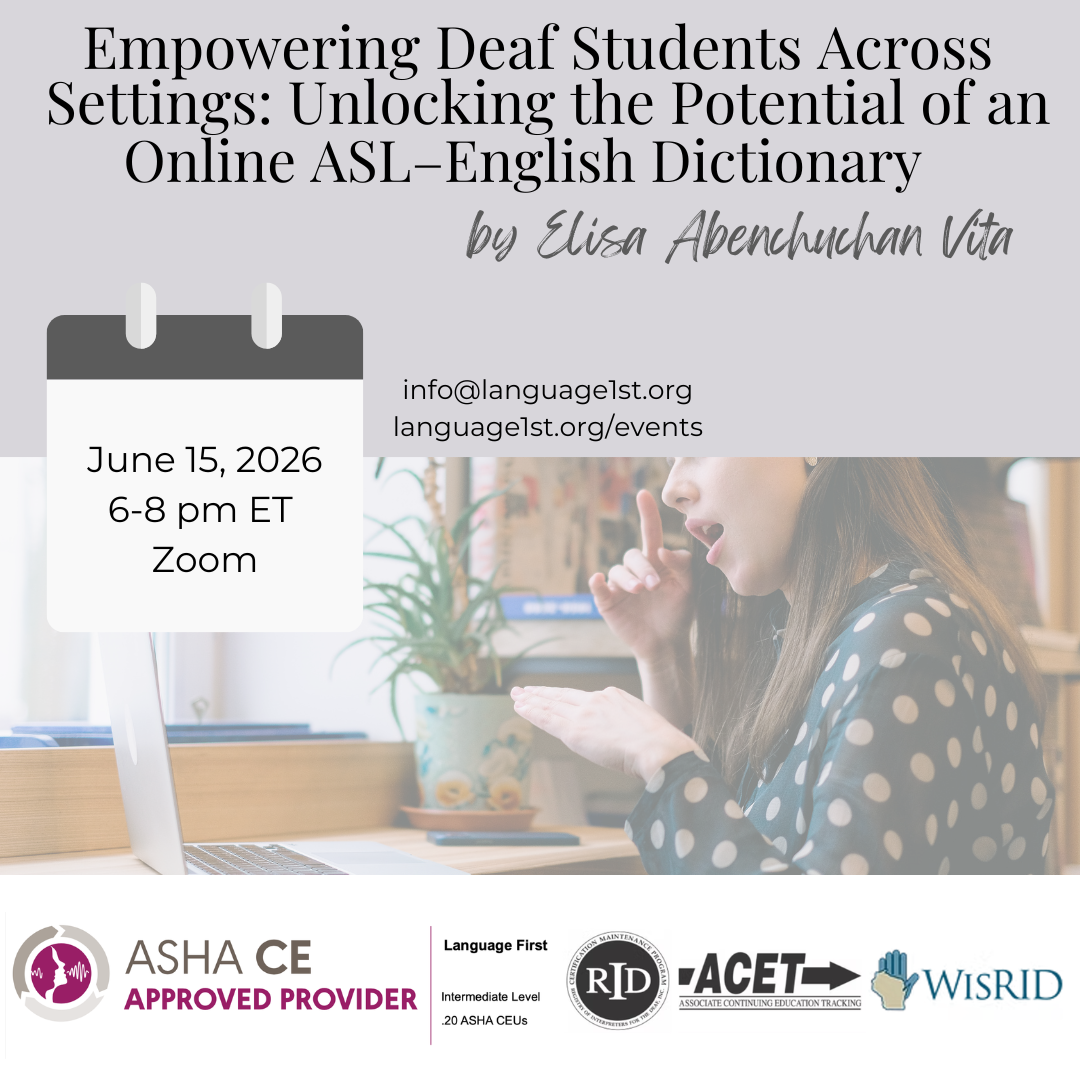 Image 1 of 2
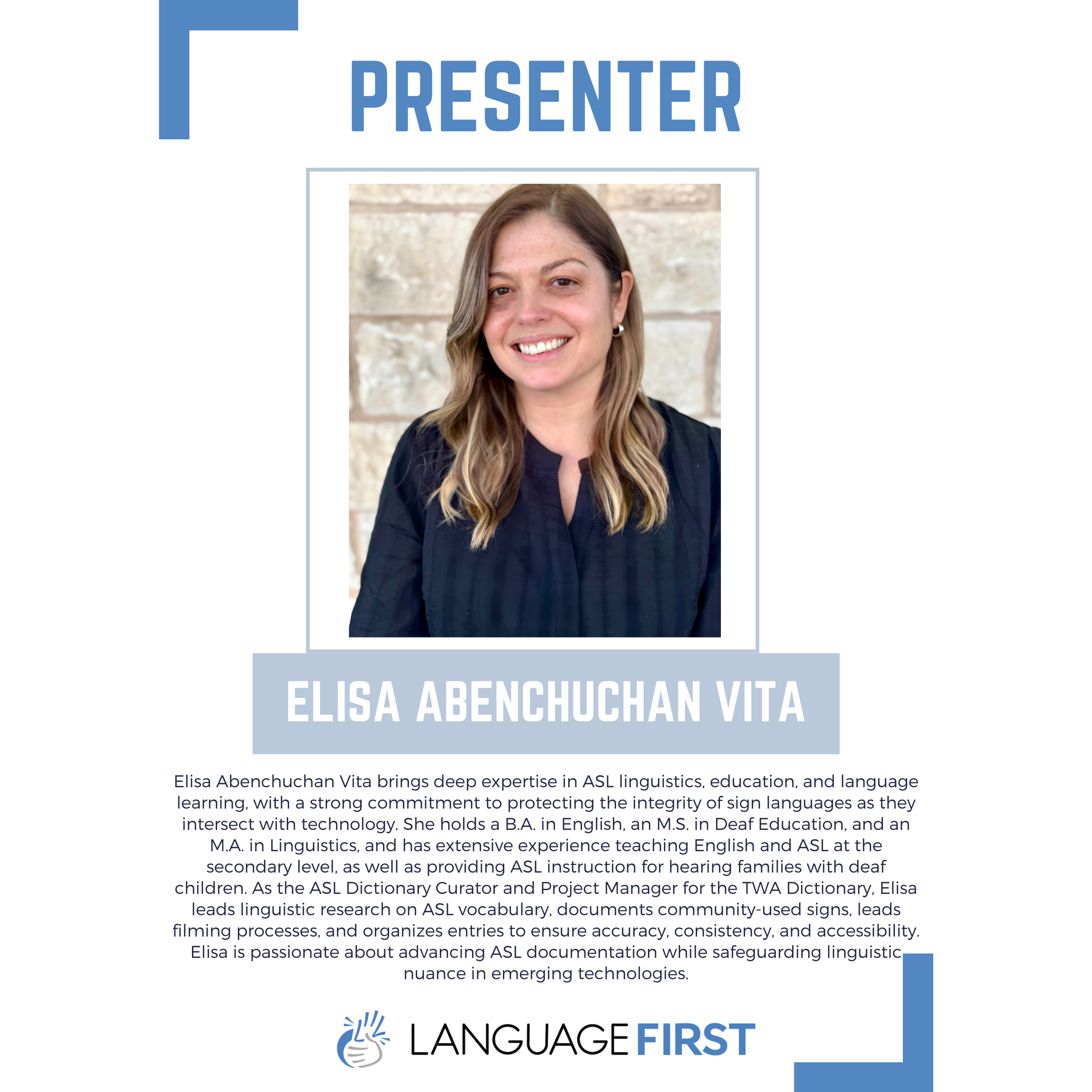 Image 2 of 2
