
Exploring Bimodal Bilingualism in Deaf Children:
A Language First x Raising Bilinguals Conference
Welcome to our first-ever Language First x Raising Bilinguals conference: Exploring Bimodal Bilingualism in Deaf Children! This conference is perfect for speech-language pathologists, teachers of the deaf, early intervention providers, researchers, parents, and families!
Want to exhibit in-person or support us by becoming a conference sponsor? Find out more here.
Saturday, November 21
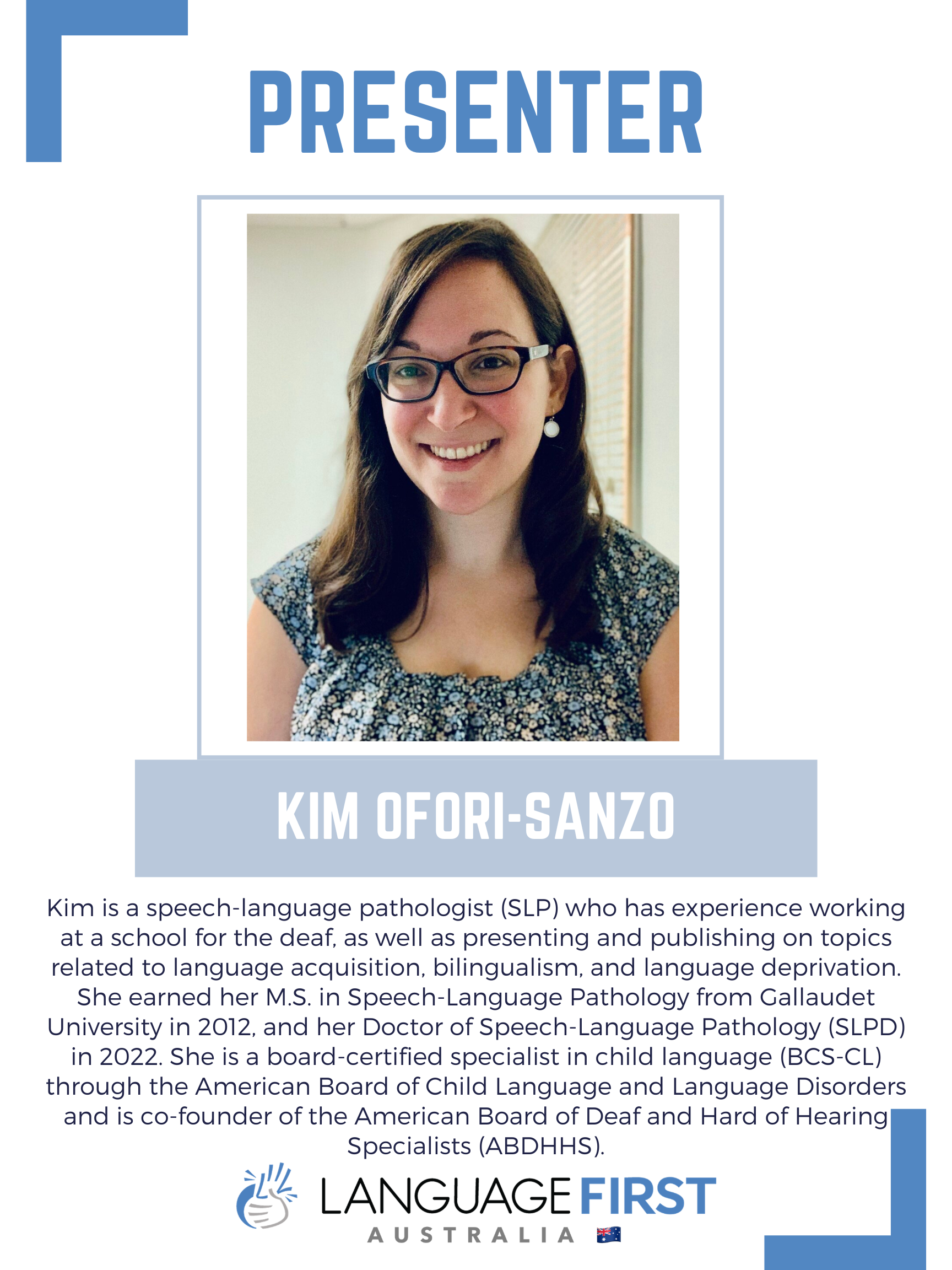
9:00 - 10:00 am - Intervention and Instructional Techniques for Deaf Children
Dr Kim Ofori-Sanzo
Session description:
This session focuses on real, practical ways to support Deaf and hard of hearing children who have experienced language deprivation. We’ll talk about what happens when children don’t have full access to language early on and how that impacts learning, thinking, and communication over time. This session is all about what to do. Participants will walk away with clear, usable strategies to support vocabulary, literacy, syntax, and overall language growth. We’ll focus on creating instruction and intervention that is fully accessible, meaningful, and bilingual Auslan-English.
Agenda:
9:00-9:10: Impact of language deprivation on cognitive-linguistic skills
9:10-9:25: Language Skill Hierarchy
9:25-9:40: Strategies for improving language fluency
9:40-9:55: Auslan-English instructional activities
9:55-10:00: Q&A
Learner Outcomes:
By the end of this presentation, participants will be able to:
Explain why providers need to use different strategies for DHH children with language deprivation
Explain why children with language deprivation need instruction/intervention in a fully accessible language
State at least two new strategies they will use with their DHH students with language deprivation
Speaker Disclosures:
Financial disclosures: Kim is the owner and founder of Language First.
Nonfinancial disclosures: Kim is a member of the American Speech and Hearing Association (ASHA), the American Board of Child Language and Language Disorders (ABCLLD), and the American Board of Deaf and Hard of Hearing Specialists (ABDHHS).
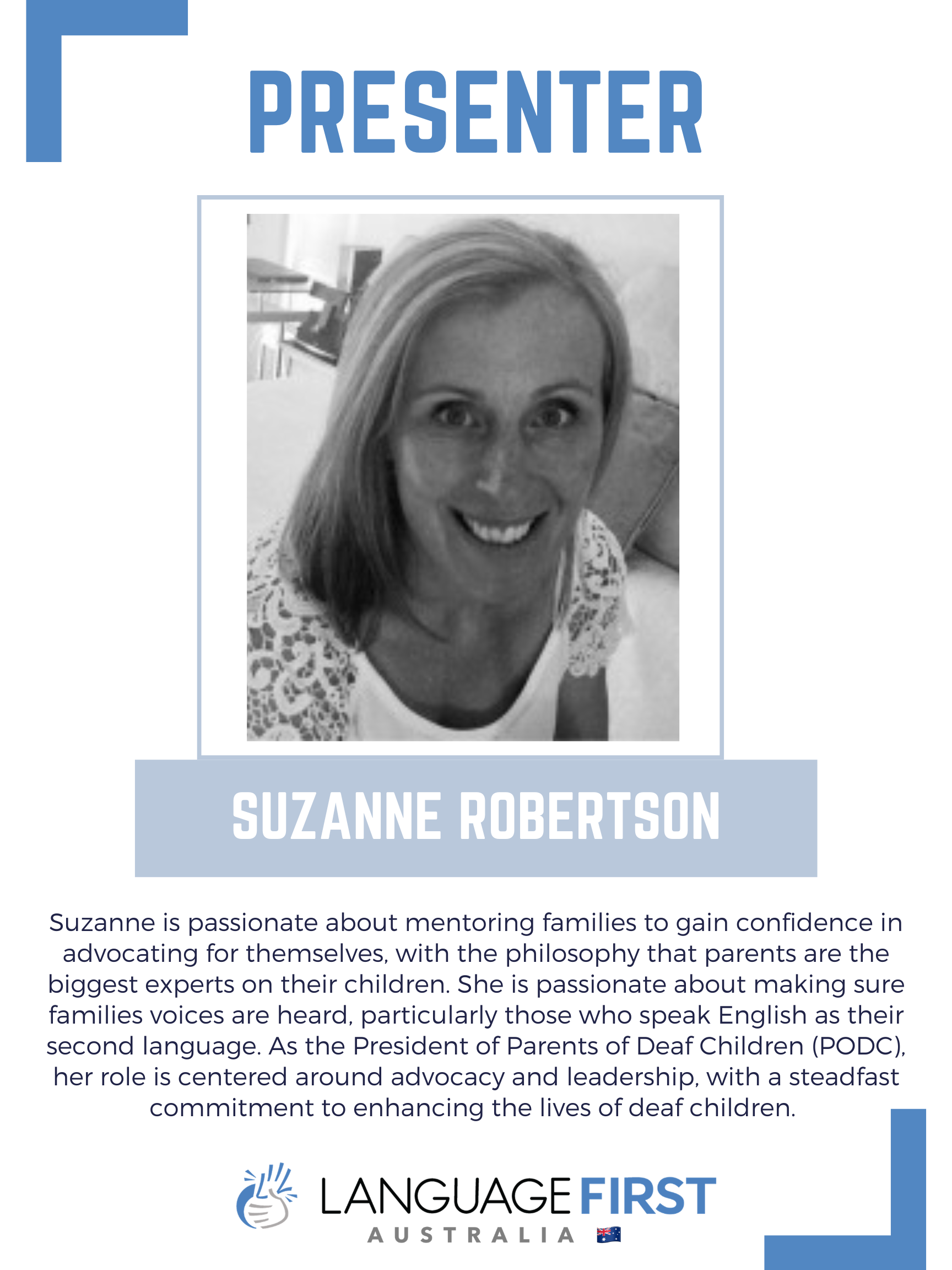
10:15 - 11:15 am - Access Is Not Support: Reframing Deaf Education Through a Language First Lens
Suzanne Robertson
Session description:
When deaf children struggle in school, the response is often to increase therapy, intervention, or support services. However, many of the barriers Deaf/deaf students experience are not caused by a lack of support — they are caused by a lack of access. Without reliable access to language, communication, and information, learning cannot occur. This presentation explores the critical distinction between support and access, and how misunderstanding this difference continues to shape educational planning, service delivery, and outcomes for Deaf/deaf students. Drawing on the experiences of families supported by Parents of Deaf Children (PODC), alongside current research and disability rights frameworks, the session will examine how reframing Deaf/deaf children’s needs through an access-based lens can strengthen participation, inclusion, and educational outcomes. Participants will explore the difference between support and access in educational environments, why language access is foundational for learning, how educational systems sometimes categorise access needs as optional supports, relevant legal and policy frameworks relating to language access and inclusive education, and practical examples of how educational environments change when language access is prioritised.
Agenda:
9:00-9:05 – Understanding the current landscape of Deaf/deaf education
9:05-9:15: Support vs access: a critical distinction
9:15-9:25: Why language access matters for learning
9:25-9:35: What the law and policy frameworks say about access
9:35-9:50: What changes when we plan through an access lens
9:50-10:00: Key insights and audience discussion
Learner Outcomes:
By the end of this presentation, participants will be able to:
Define the distinction between educational support and access in the context of Deaf/deaf education
Describe why language access is foundational to learning and participation for Deaf/deaf children
Identify practical strategies for prioritising language access within educational environments
Speaker Disclosures:
Financial disclosures: Suzanne has no relevant financial disclosures.
Nonfinancial disclosures: Suzanne Robertson is the President of Parents of Deaf Children (PODC) NSW/ACT, a volunteer-led organisation that supports families of Deaf/deaf children. This role informs her perspectives regarding family experiences navigating education systems, disability services, and language access. The presentation may reference experiences shared by families involved with PODC and advocacy work undertaken by the organisation.
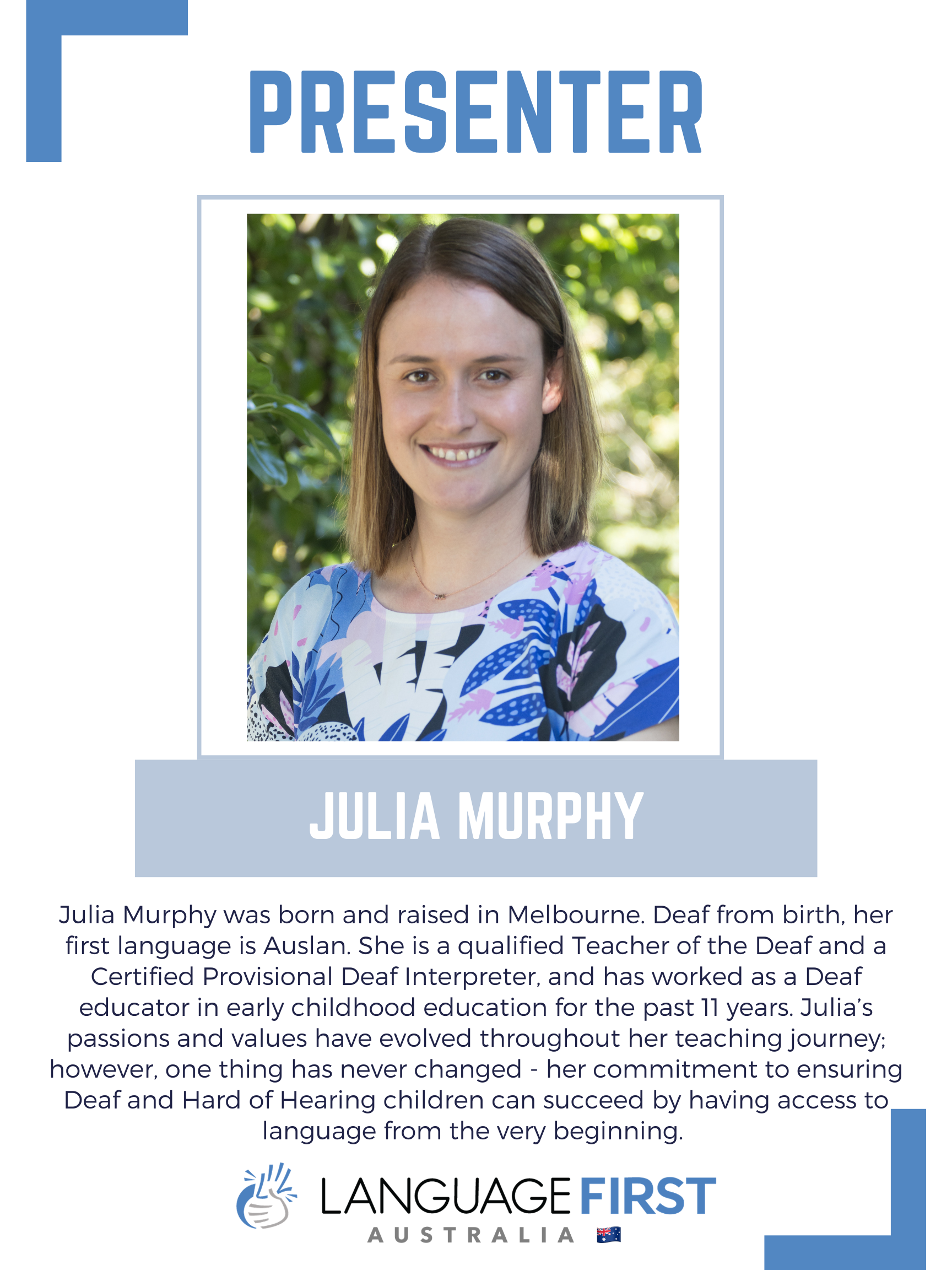
11:30 - 12:30 pm - Because of Auslan
Julia Murphy
Session description:
What is it like to be a Deaf person in a hearing family? Join me as I share my experiences growing up with access to rich language and endless opportunities that continue to shape my identity today. We will dive into personal stories from my childhood, Deaf education, and the Deaf Community that has empowered me endlessly. This session will also explore the power of Deaf role models and the impact they can have on young Deaf and Hard of Hearing children.
Agenda:
5 minutes: Introduction 10 minutes: A snapshot of my growing up in a hearing family 10 minutes: The lightbulb moment – If she can, I can. 10 minutes: That sense of belonging 10 - 15 minutes: My Why (the mission for Deaf Education) 10 minutes: Q/A’s
Learner Outcomes:
By the end of this presentation, participants will be able to:
Explain the impact of receiving early access to language in developing a sense of identity and belonging
Define the purpose of having Auslan – for it to not be seen as a limitation, but to recognise what can be gained
State how Deaf role models and their lived experiences positively impact DHH children
Speaker Disclosures:
Financial disclosures: Julia is receiving payment from Language First for presenting.
Nonfinancial disclosures: Julia is a committee member of Australian Sign Language Interpreters’ and Translators’ Association (ASLITA)
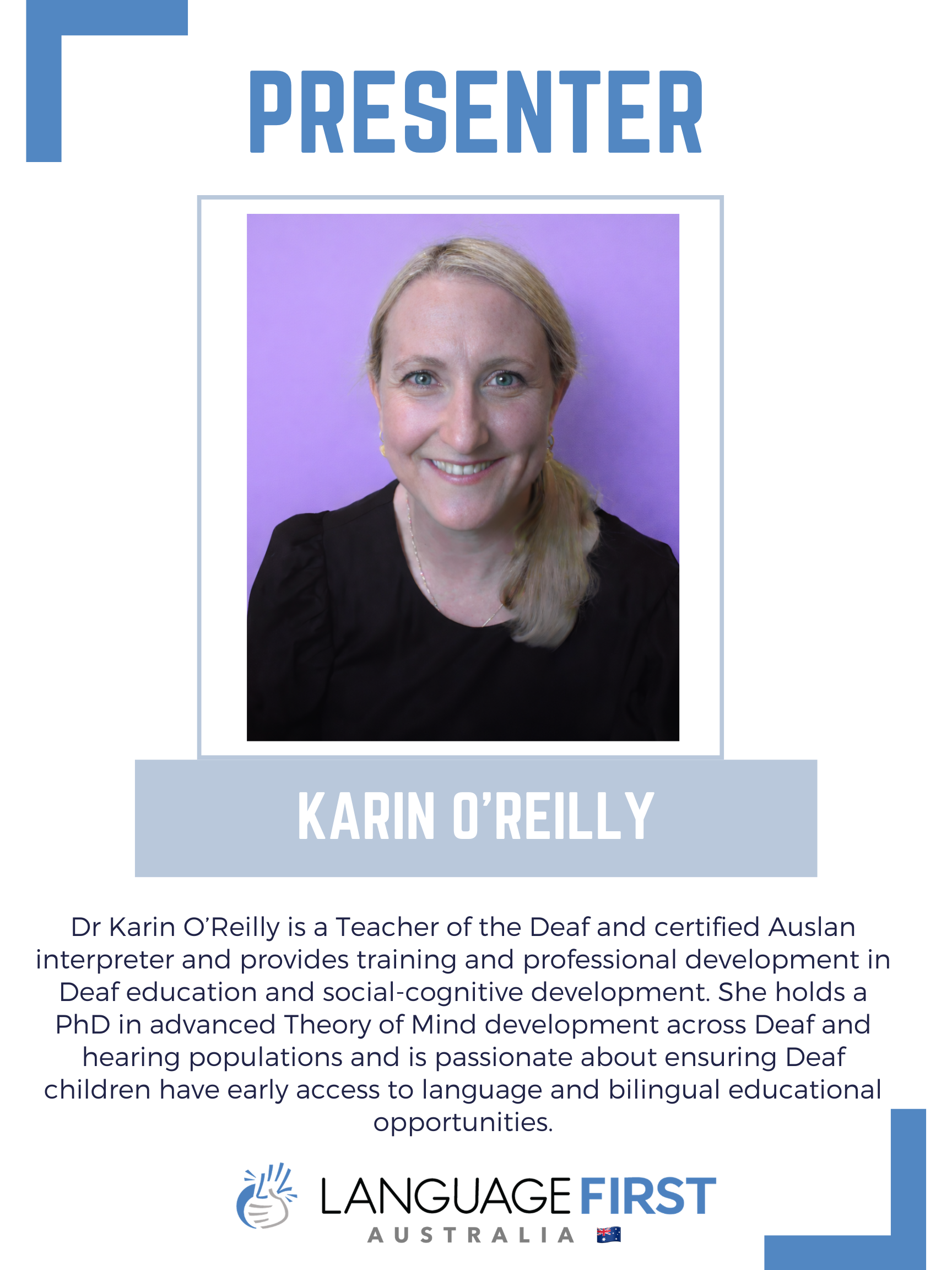
1:30 - 2:30 pm - Seeing Minds: Language Access, Brain Architecture, and the Social Lives of Deaf Children
Dr Karin O’Reilly
Session description:
This presentation reframes Theory of Mind (ToM) development in Deaf children through a strengths-based, evidence-informed, bilingual lens. Rather than positioning ToM variability as an inherent consequence of deafness, the session demonstrates how language access and conversational richness shape social-cognitive development across childhood and into adulthood. Drawing on two peer-reviewed studies conducted by the presenter, participants will examine lifespan findings on advanced Theory of Mind and sarcasm understanding in deaf native and late signers, as well as research linking Theory of Mind to peer popularity, social isolation, and leadership in middle childhood. These empirical findings are integrated with contemporary neuroscience on brain development and sensitive periods to explain how early accessible language shapes neural architecture and long-term social outcomes.
Agenda:
10:15-10:20: Opening narrative case example and framing of Theory of Mind as an access issue rather than a deficit
10:20-10:28: What is Theory of Mind? Definition, developmental progression, and relevance to education and social wellbeing
10:28-10:40: Research Study 1 – Advanced Theory of Mind and sarcasm across childhood and adulthood (lifespan findings and implications for early access)
10:40-10:50: Brain development and sensitive periods – neural architecture, mental-state language, and why early conversational access matters
10:50-11:02: Research Study 2 – Theory of Mind, peer popularity, social isolation, and leadership outcomes in middle childhood 8 minutes: The Three Doors to Theory of Mind framework – practical integration for teachers, interpreters, SLPs, and families
11:02-11:07: Conclusion and community call to action
11:07-11:15: Q&A
Learner Outcomes:
By the end of this presentation, participants will be able to:
Define Theory of Mind and describe how language access influences its development across childhood and adulthood
Explain the relationship between early language exposure, neural architecture, and advanced Theory of Mind outcomes
Identify and apply at least three practical strategies aligned with the “Three Doors to Theory of Mind” framework to support social-cognitive development in Deaf children
Speaker Disclosures:
Financial disclosures: Dr O’Reilly is receiving an honorarium from Language First for presenting. She is also employed in a leadership role within the Queensland Department of Education and operates a sole consultancy providing assessment and advisory services in Deaf education and social-cognitive development.
Nonfinancial disclosures: The views expressed in this presentation are informed by her research and professional practice and do not represent official policy positions of the Queensland Department of Education. She has no other nonfinancial relationships that would be perceived as creating a conflict of interest.
3:45 - 3:45 pm - The Association Between Early Life Access to Communication and Mental Health Outcomes Among Deaf People: Findings from a National Survey of the Australian Deaf Community
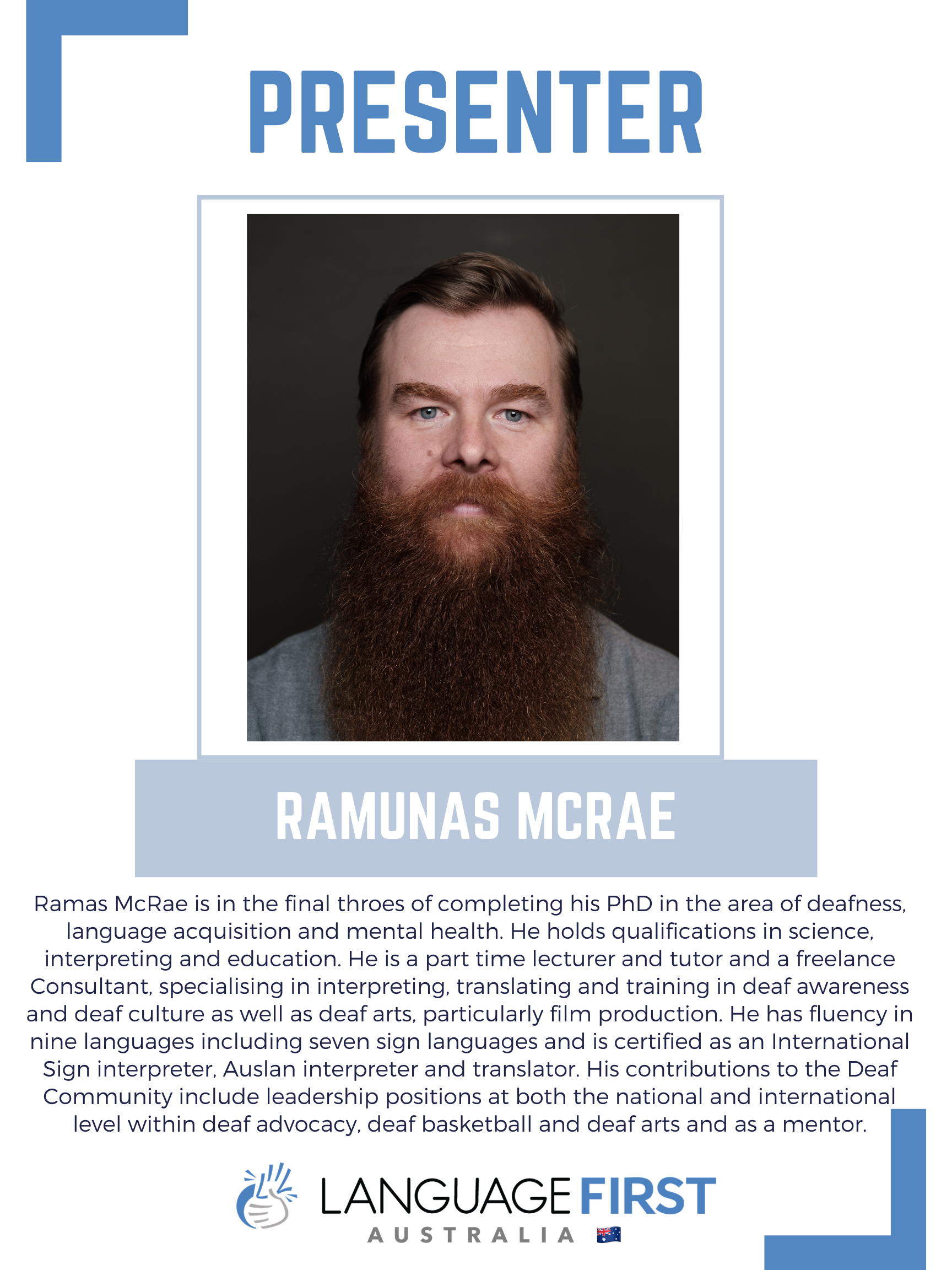
Dr Ramas McRae
Session description:
This presentation shares findings from a national survey examining how early life access to communication influences mental health outcomes among deaf people in Australia. Deaf individuals experience higher rates of adverse mental health compared with hearing populations. Previous qualitative research has shown that communication barriers within families and school environments can contribute to poorer mental health, while access to deaf community spaces and culturally safe communication environments can support wellbeing. This study involved 340 deaf Australian adults who completed an accessible online survey exploring early life communication experiences, education, and self-reported mental health outcomes. The findings indicate that participants who attended mainstream schools, particularly those without specialised deaf facilities, reported significantly higher odds of depression and suicidal ideation compared with those who attended deaf schools. Participants who did not have access to deaf community spaces during adolescence also reported higher levels of suicidal ideation. These findings highlight the critical role that accessible communication, inclusive education environments, and connection to deaf spaces play in supporting positive long-term mental health outcomes for deaf individuals.
Agenda:
1:30-1:35: Introduction and overview
1:35-1:45: Background and research context
1:45-2:00: Study design and methodology
2:00-2:20: Key findings and interpretation
2:20-2:30: Implications and discussion, audience Q&A
Learner Outcomes:
By the end of this presentation, participants will be able to:
Describe the relationship between early life communication access and mental health outcomes among deaf individuals
Identify key factors within family, education, and community environments that influence positive and adverse mental health outcomes for deaf people
Explain practical strategies that education providers and support services can implement to improve communication access and support positive mental health outcomes for deaf students
Speaker Disclosures:
Financial disclosures: Dr McRae is receiving payment from Language First for presenting.
Nonfinancial disclosures: Dr McRae has no relevant nonfinancial disclosures.
4:00 - 5:00 pm - Using Data to Ensure Language Equity for Children Who Use Sign Language
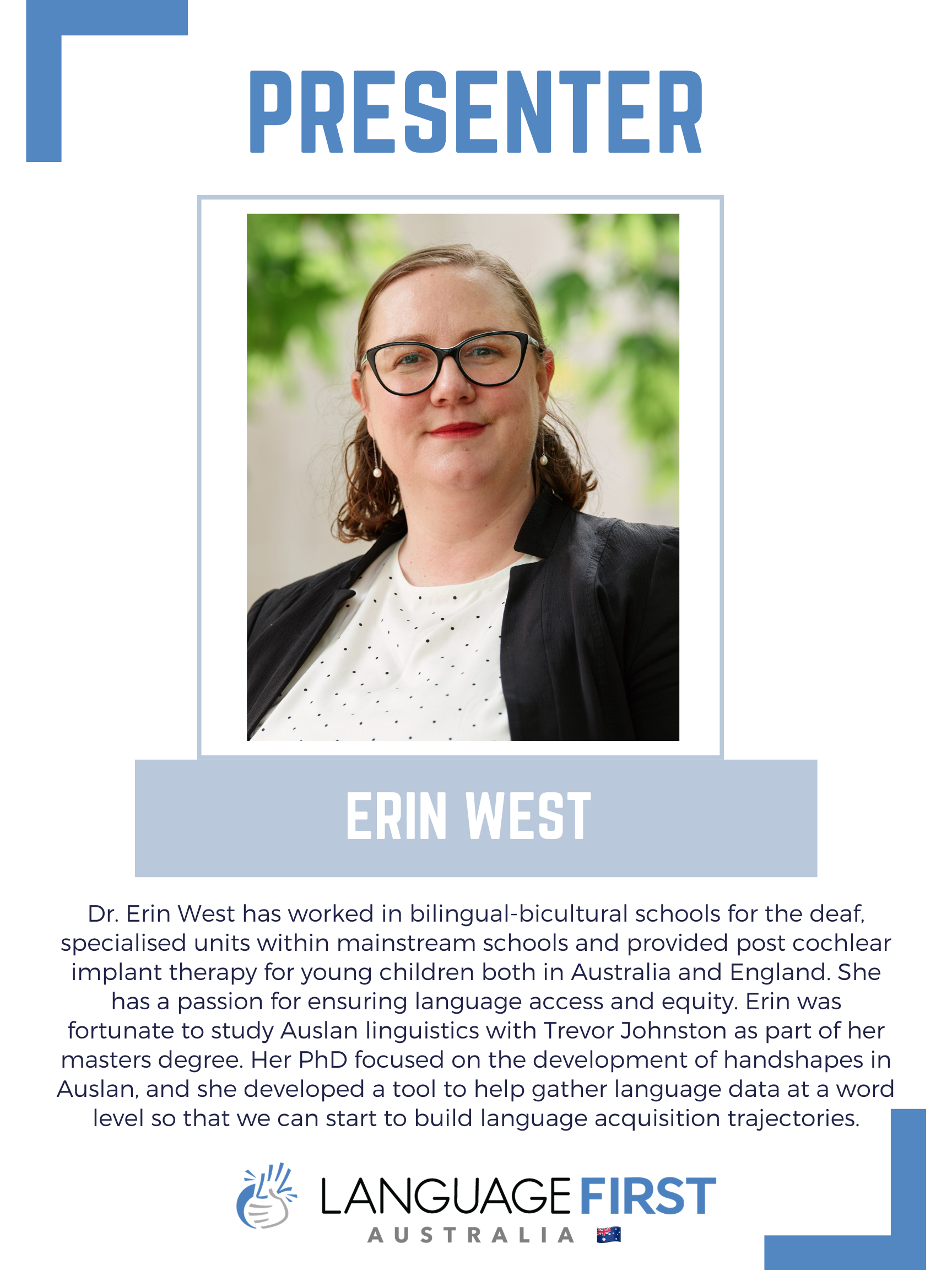
Dr Erin West
Session description:
The presentation will discuss data gaps that exist in the acquisition of sign languages and how we might start to address them through a lens of language equity. Past and current research about sign language phonology will be shared, including the first data we have on children's spontaneous use of handshapes in Auslan. The presentation will introduce participants to the Handshape Analysis Recording Tool and concepts that they can use in their own practice.
Agenda:
Introduction of concepts (15 min) What is language equity Differences between ASL and Auslan Language vulnerability How do we gather data in spoken languages History of sign language acquisition data (10 minutes) Focus on ASL and BSL Introduce HART & data (15 minutes Handshape Analysis Recording Tool & validation study Handshape data Lexical data Why does it matter? What can you do? (10 minutes) Questions (10 minutes)
Learner Outcomes:
By the end of this presentation, participants will be able to:
Describe the influence of data on language equity
Use data gathering principles such as language sampling in their practice
State the current data gathering tools that are available in Australia
Speaker Disclosures:
Financial disclosures: Dr West is receiving payment from Language First for presenting. She also works for Speech Pathology Australia, but this is unrelated to her research.
Nonfinancial disclosures: Dr West has an honorary appointment at the University of Melbourne.