This webinar will be hosted via Zoom for national and international attendees on Sunday, October 4, 2026 from 1:00 - 4:00 pm ET.
Speaker Disclosures:
Financial disclosures: Amanda is receiving payment from Language First for presenting.
Nonfinancial disclosures: Amanda is a member of RID and NAIE. In collaboration with Dr. Laura Polhemus (Bethel University), she is researching neurodiversity in the interpreting profession and runs @SLINeurodiversity on FB/IG.
Course Description:
Neurodiversity has become a hot topic on social media, however, research and discussions have been limited within the interpreting field despite many neurodivergent interpreters and consumers regularly experiencing stigma due to their perceived differences. Systemic barriers within the medical, mental health, and education systems have a profound impact on hard of hearing, d/Deaf, DeafBlind, and DeafDisabled consumers. Specifically, BIPOC students are significantly less likely to receive a diagnosis and more likely to be referred for disciplinary action compared to white students. For Deaf students, access to diagnoses and accommodations is further complicated by the fact that assessments are standardized towards the hearing norm and administered in English. In addition to embracing their intersectional identities, it is critical to gain a better understanding of neurodiversity as a whole in order to address the unconscious bias, stigma, and discrimination.
Drawing from lived experience, professional practice, and research, Amanda will introduce participants to the behavioral, socio-emotional, linguistic, and ethical considerations interpreters encounter while working with neurodivergent hard of hearing, d/Deaf, DeafBlind, and DeafDisabled students in educational settings. As participants examine these considerations and the stigma surrounding neurodiversity, they will also integrate research and best practices to develop strategies for ethical, effective, and neuro-affirming interpreting services as part of the educational team.
Although this workshop is presented from an interpreter’s perspective, teachers, related service providers, and other educational team members are welcome to attend.
Agenda
1:00-1:05: Introduction & Educational Objectives
1:05-1:50: Stigma & Stereotypes
1:50-2:30: Behavioral & Social-Emotional Considerations
2:30-3:00: Linguistic Considerations
3:00-3:45: Ethical Considerations
3:45-4:00: Wrap-Up: Q&A, References & Resources
Learner Outcomes:
Participants will be able to:
Provide at least two examples of how students are impacted by the intersectionality of race, deafness, neurodivergence, and/or other identities.
Describe at least one consideration from each of the following categories: behavioral, socio-emotional, linguistic, and ethical.
Integrate research in order to formulate interpreting strategies to utilize while working with neurodivergent students, including atypical language users, such as teaming, technological resources, and props.
Registration information:
This is a digital purchase only; no physical ticket is provided. A form will populate for you to complete your registration and then your purchase will be added to your cart in the upper right-hand corner of the screen. You will receive an email with instructions on how to participate as well as a Google Calendar invite with the Zoom link one week prior to the event. Registration ends one day prior to the webinar. All registrants will receive a copy of the presenter’s PowerPoint and the presentation recording. Please email info@language1st.org with any questions.
This webinar will be hosted via Zoom for national and international attendees on Sunday, October 4, 2026 from 1:00 - 4:00 pm ET.
Speaker Disclosures:
Financial disclosures: Amanda is receiving payment from Language First for presenting.
Nonfinancial disclosures: Amanda is a member of RID and NAIE. In collaboration with Dr. Laura Polhemus (Bethel University), she is researching neurodiversity in the interpreting profession and runs @SLINeurodiversity on FB/IG.
Course Description:
Neurodiversity has become a hot topic on social media, however, research and discussions have been limited within the interpreting field despite many neurodivergent interpreters and consumers regularly experiencing stigma due to their perceived differences. Systemic barriers within the medical, mental health, and education systems have a profound impact on hard of hearing, d/Deaf, DeafBlind, and DeafDisabled consumers. Specifically, BIPOC students are significantly less likely to receive a diagnosis and more likely to be referred for disciplinary action compared to white students. For Deaf students, access to diagnoses and accommodations is further complicated by the fact that assessments are standardized towards the hearing norm and administered in English. In addition to embracing their intersectional identities, it is critical to gain a better understanding of neurodiversity as a whole in order to address the unconscious bias, stigma, and discrimination.
Drawing from lived experience, professional practice, and research, Amanda will introduce participants to the behavioral, socio-emotional, linguistic, and ethical considerations interpreters encounter while working with neurodivergent hard of hearing, d/Deaf, DeafBlind, and DeafDisabled students in educational settings. As participants examine these considerations and the stigma surrounding neurodiversity, they will also integrate research and best practices to develop strategies for ethical, effective, and neuro-affirming interpreting services as part of the educational team.
Although this workshop is presented from an interpreter’s perspective, teachers, related service providers, and other educational team members are welcome to attend.
Agenda
1:00-1:05: Introduction & Educational Objectives
1:05-1:50: Stigma & Stereotypes
1:50-2:30: Behavioral & Social-Emotional Considerations
2:30-3:00: Linguistic Considerations
3:00-3:45: Ethical Considerations
3:45-4:00: Wrap-Up: Q&A, References & Resources
Learner Outcomes:
Participants will be able to:
Provide at least two examples of how students are impacted by the intersectionality of race, deafness, neurodivergence, and/or other identities.
Describe at least one consideration from each of the following categories: behavioral, socio-emotional, linguistic, and ethical.
Integrate research in order to formulate interpreting strategies to utilize while working with neurodivergent students, including atypical language users, such as teaming, technological resources, and props.
Registration information:
This is a digital purchase only; no physical ticket is provided. A form will populate for you to complete your registration and then your purchase will be added to your cart in the upper right-hand corner of the screen. You will receive an email with instructions on how to participate as well as a Google Calendar invite with the Zoom link one week prior to the event. Registration ends one day prior to the webinar. All registrants will receive a copy of the presenter’s PowerPoint and the presentation recording. Please email info@language1st.org with any questions.

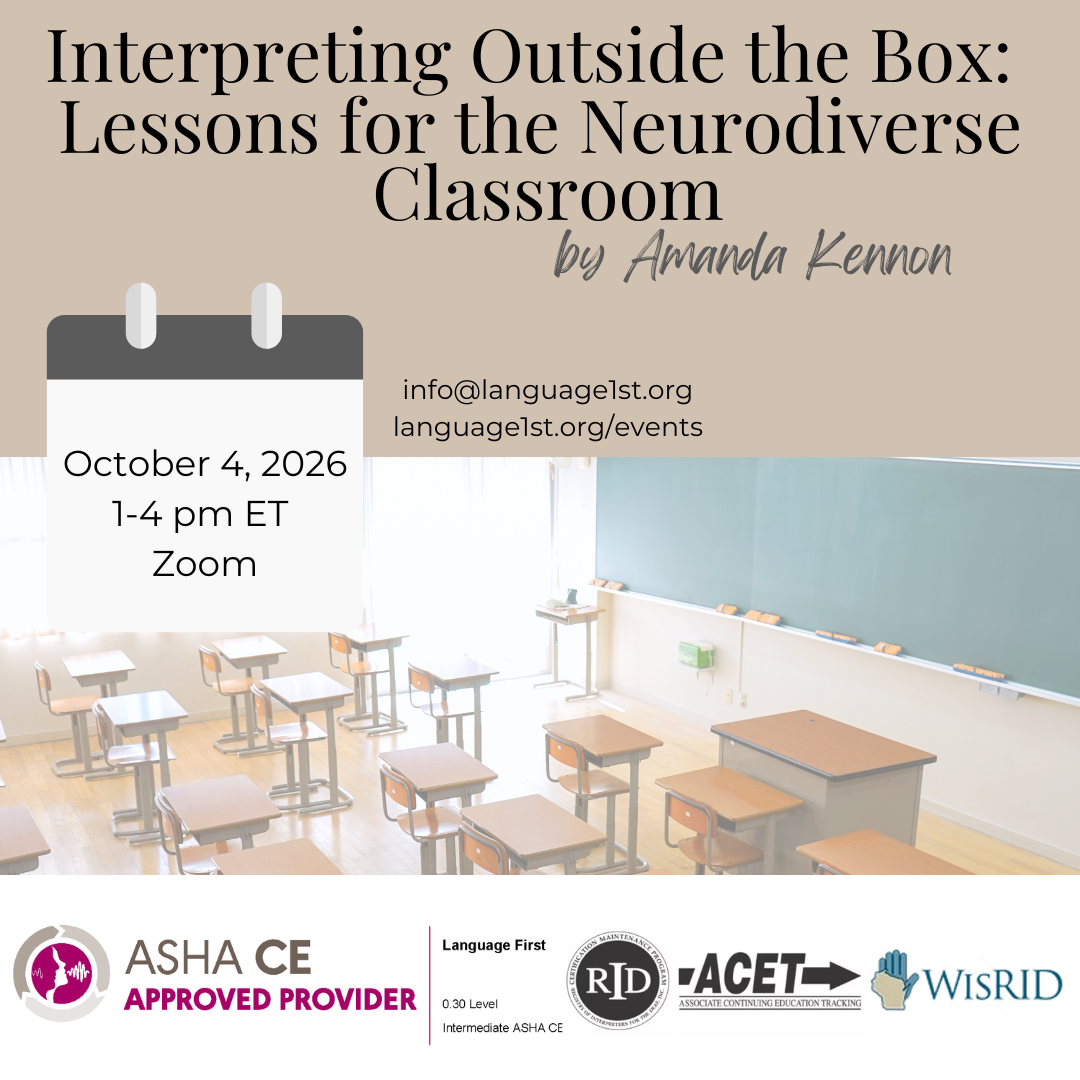 Image 1 of 2
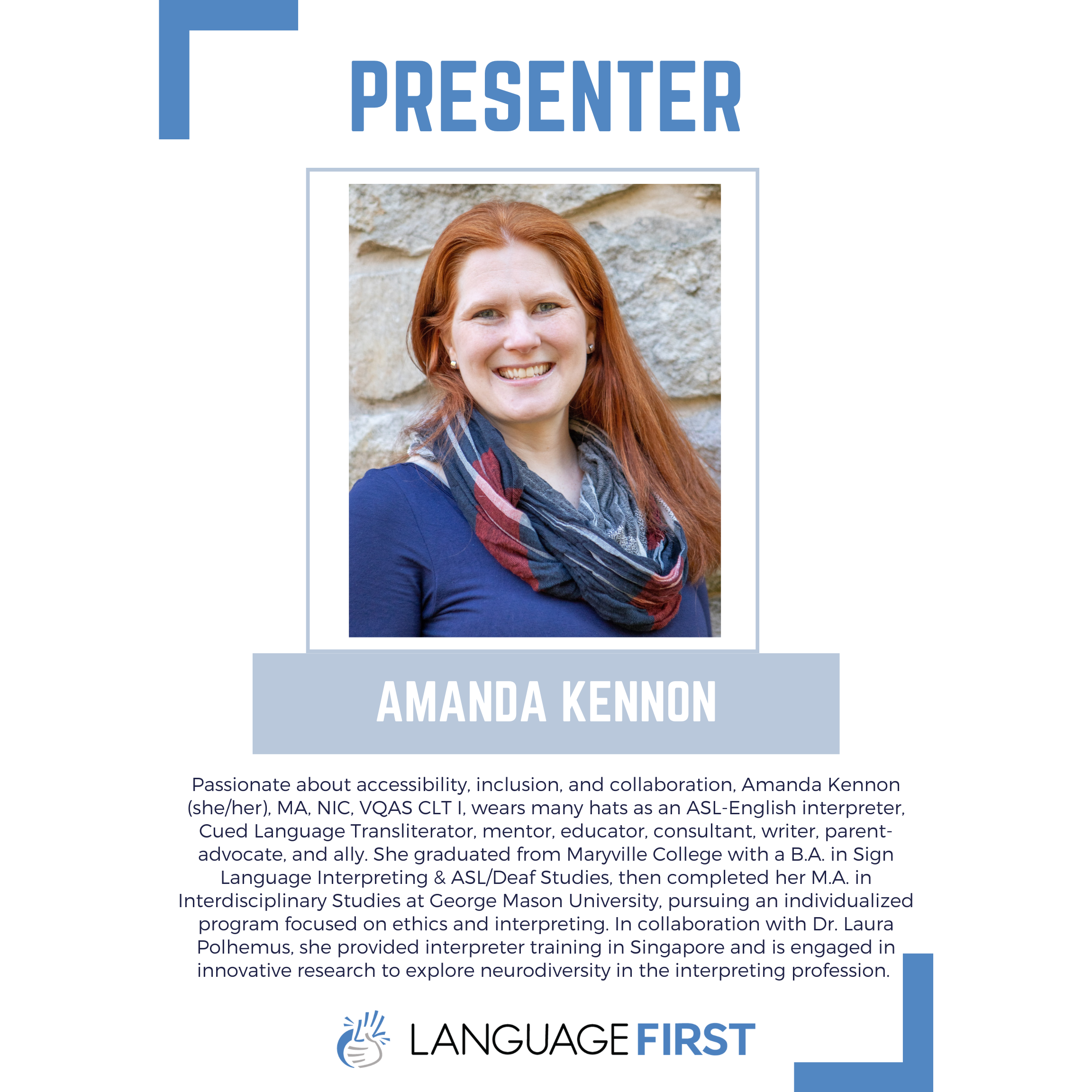 Image 2 of 2
