
At Language First, we’re proud to partner with educators, therapists, and specialists who share our commitment to early language access for Deaf and hard of hearing (DHH) children. This space is designed to support your work with evidence-based resources, ASL-rich learning materials, and collaborative opportunities.
Assessment
Order physical and/or digital assessments, or explore our comprehensive chart featuring a wide range of formal and informal ASL assessments.
Intervention
Browse fun and interactive intervention and instructional activities to use with your Deaf students in language treatment sessions or in the classroom.
Resources
Browse graphics, handouts, hierarchies, and infographics explaining a variety of topics and concepts related to evidence-based practice when working with Deaf children.
Job Listings
This is where employers searching for ASL-English bilingual professionals post their openings. New positions are added often, so check back regularly!
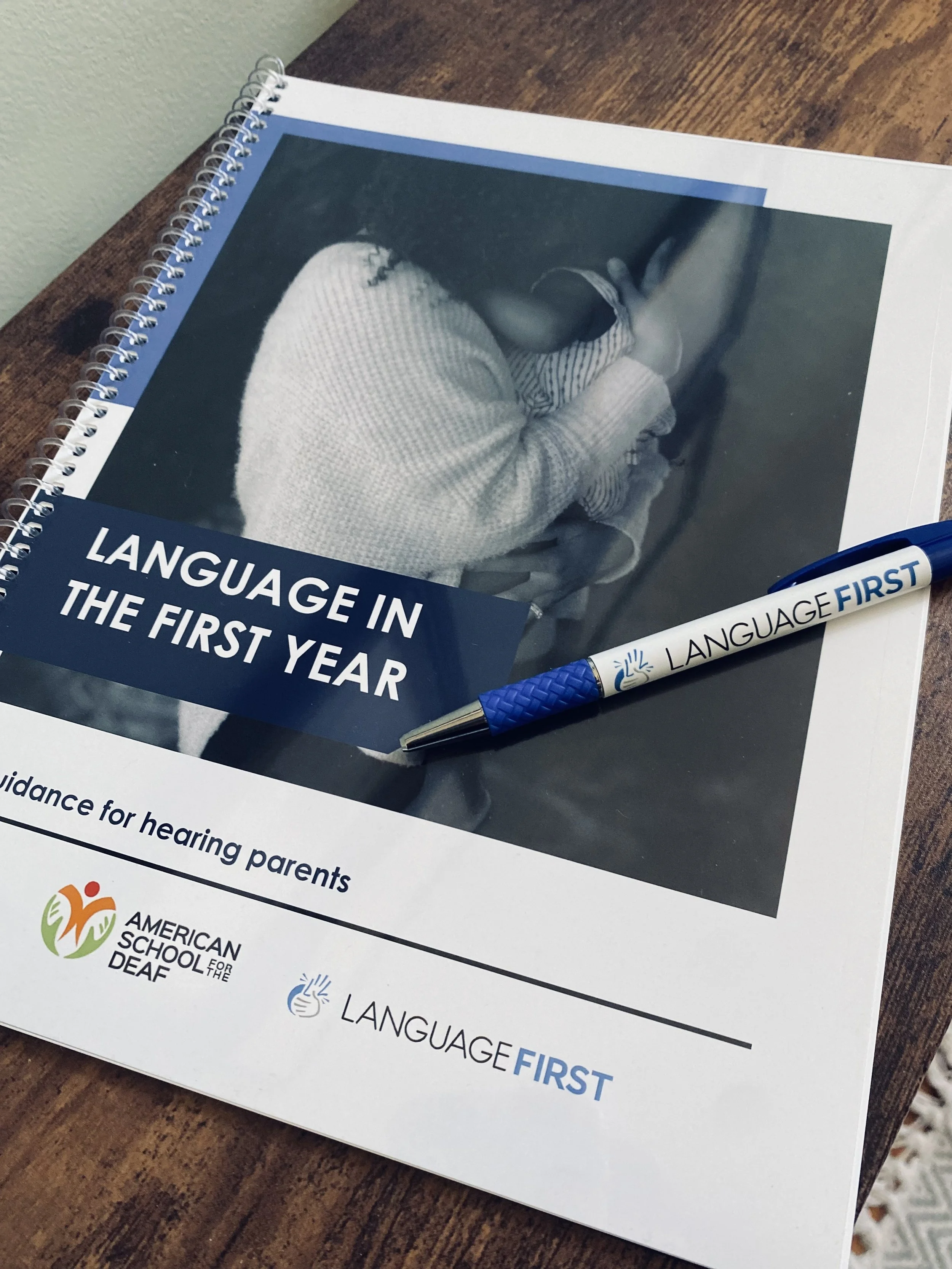
Language in the First Year | Resource
The first year of life is a critical period rich in language, cognitive, social, emotional, and motor development. This resource guides parents and providers month-by-month through a Deaf or hard of hearing (DHH) baby’s first year, highlighting what to expect and what to focus on along the way.
Leverage the Evidence
-
Find out why it is so important to use a natural signed language like ASL with Deaf children who have cochlear implants (CIs).
-
Explore our list of hyperlinked research articles, organized alphabetically with Deaf authors highlighted.
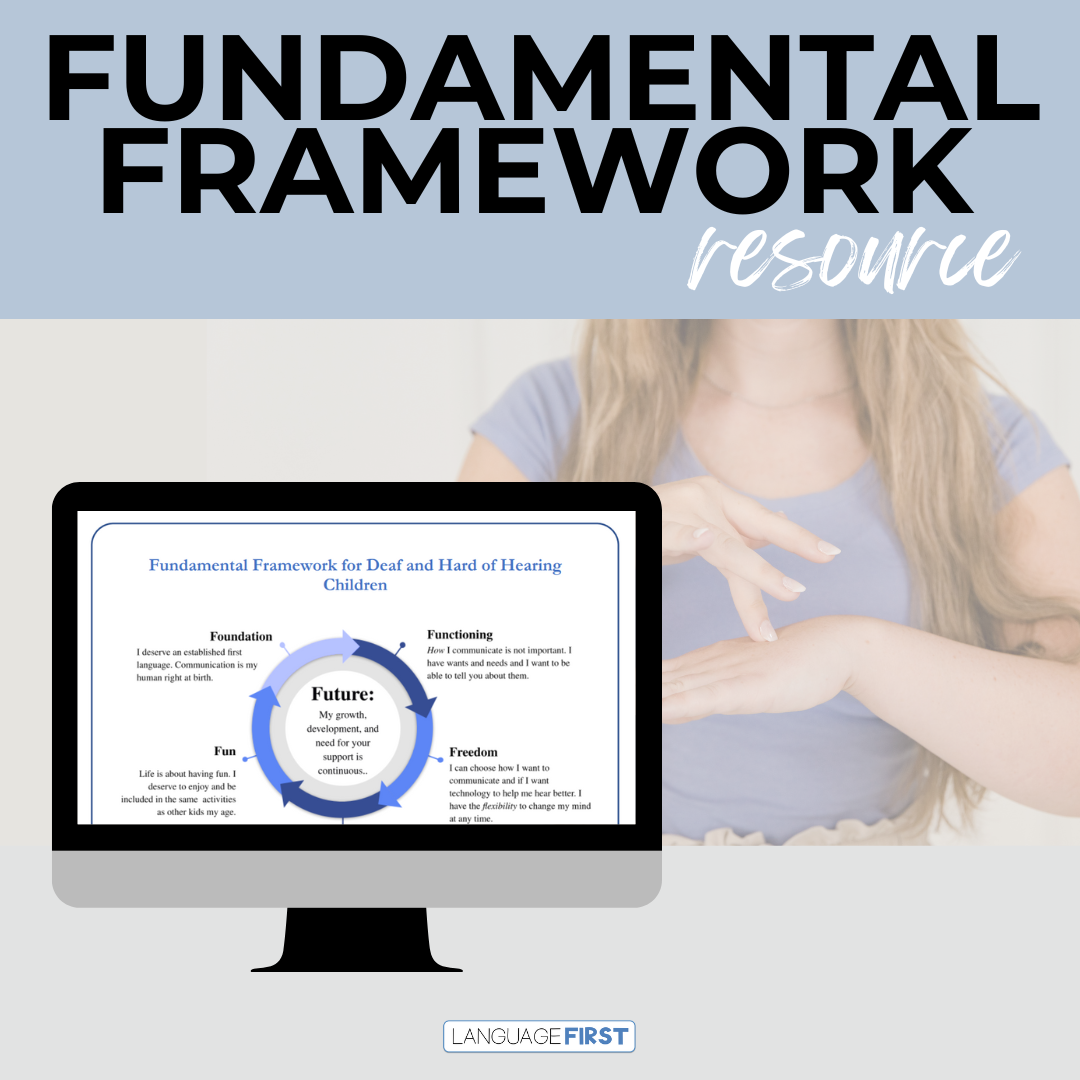
The Fundamental Framework for Deaf and hard of hearing (DHH) children is a framework created by Kinya Embry-Wright, PhD, CCC-SLP and modeled after The ICF Framework and the F-Words (Rosenbaum & Gorter, 2012). This model proposes that decision-making around a DHH child’s language opportunities should be a collaborative effort among parents and professionals that includes the desires and opinions of the DHH child. The framework highlights client-centered care and de-emphasizes the historical approach of “fixing” reduced hearing in children.
This 5-page document explains each concept in the framework, the DHH child’s statement that goes with it, and offers suggested questions for parents and providers to ask each other and the DHH child. The questions help ensure that the DHH child’s voice is heard and that their rights and autonomy are respected.

This hierarchy is intended to help clinicians choose appropriate language skills to target with Deaf students with language deprivation. There are no ages or grade levels, as it is meant to match the student's current language abilities. It is also meant to be language-agnostic so that it can be used in oral or signed language as a guide for goal writing and activity planning. However, skills should be targeted in American Sign Language (ASL) first. If a Deaf child already has language deprivation, they need intensive language treatment in a fully accessible language (i.e., ASL). Clinicians should not begin to introduce printed English (aside from letters) until the child is at Level 2.
The document contains a link to a Google Doc version that is live and editable by multiple providers simultaneously.

Use this resource to help document and analyze the errors your students are making in ASL. For phonological errors, you check HS for a handshape error, PO for a palm orientation error, L for a location error, M for a movement error, and NMM for a nonmanual marker error. You can also note A for an approximation, G for a gesture, or U for unintelligible. This will help you find patterns in the errors and guide your treatment. For articulatory errors, this free resource is linked within the document to help you describe what you see.
Note: This document is included within the Informal Assessment for Language Deprivation.

Membership
-
Basic
Monthly resources
Special Interest Groups (SIGs)
Exclusive video content
ASL coffee hour
-
Standard
All basic benefits, PLUS:
Monthly webinar code
Webinar archive
10% off conference registration
-
Scholar
Full access to all recorded courses in the Learning Library
10% off conference registration
Do you want to know more about how to best assess or treat your DHH students?
Principles to guide your early intervention practice.
Check out our free, self-guided training in the Language First birth to 5 framework. Professionals who follow this framework focus on a DHH child’s strengths, rather than their deficits, and always place the child’s best interests first.
Join our Facebook group and connect with like-minded professionals.
Future Professionals
By supporting graduate students, we help shape the future leaders of our field.
-
If you are looking into graduate programs in speech-language pathology and want one that is Deaf-friendly, check out our list of recommended schools and programs.
-
This free resource helps guide SLP graduate students who are interested in working with DHH children.
-
Our Student Ambassador Program (SAP) is for current Communication Sciences and Disorders (CSD) students who have a passion for Deaf children and enjoy learning, networking, and engaging in service work.