Assessments
We’re pleased to announce that the ASL-VT, ASL-RST, and ASL-EST will soon have a new home at Language First. We look forward to supporting the next chapter of these valuable assessment tools.
Stay tuned for more information!

The American Sign Language Receptive Skills Test (ASL-RST) is a developmental assessment for children, aged 3 to 13 years, learning ASL. It measures children’s understanding of ASL grammar, including number/distribution, negation, noun/verb distinction, spatial verbs (location and movement), size/shape specifiers, handling classifiers, role shift, and conditionals.
The ASL-RST consists of a vocabulary check of 20 words, 2 practice items, and a total of 42 test items, and take approximately 10-15 minutes to administer.
The ASL-RST package includes the test manual (including the reproducible score sheet); a USB (with all video and picture test stimuli); a set of 20 picture cards (for the vocabulary check); and a plastic carrying case.
*Be sure to select the ASL-RST shipping fee ($10) at checkout.
Note: Language First is the United States distributor for the ASL-RST, created by Northern Signs Research. If you would like to purchase this assessment using a purchase order (PO), please email info@language1st.org. All purchase orders must include a flat rate $10.00 shipping charge per assessment. Find out more about the assessment here.

This hierarchy is intended to help clinicians choose appropriate language skills to target with Deaf students with language deprivation. There are no ages or grade levels, as it is meant to match the student's current language abilities. It is also meant to be language-agnostic so that it can be used in oral or signed language as a guide for goal writing and activity planning. However, skills should be targeted in American Sign Language (ASL) first. If a Deaf child already has language deprivation, they need intensive language treatment in a fully accessible language (i.e., ASL). Clinicians should not begin to introduce printed English (aside from letters) until the child is at Level 2.
The document contains a link to a Google Doc version that is live and editable by multiple providers simultaneously.
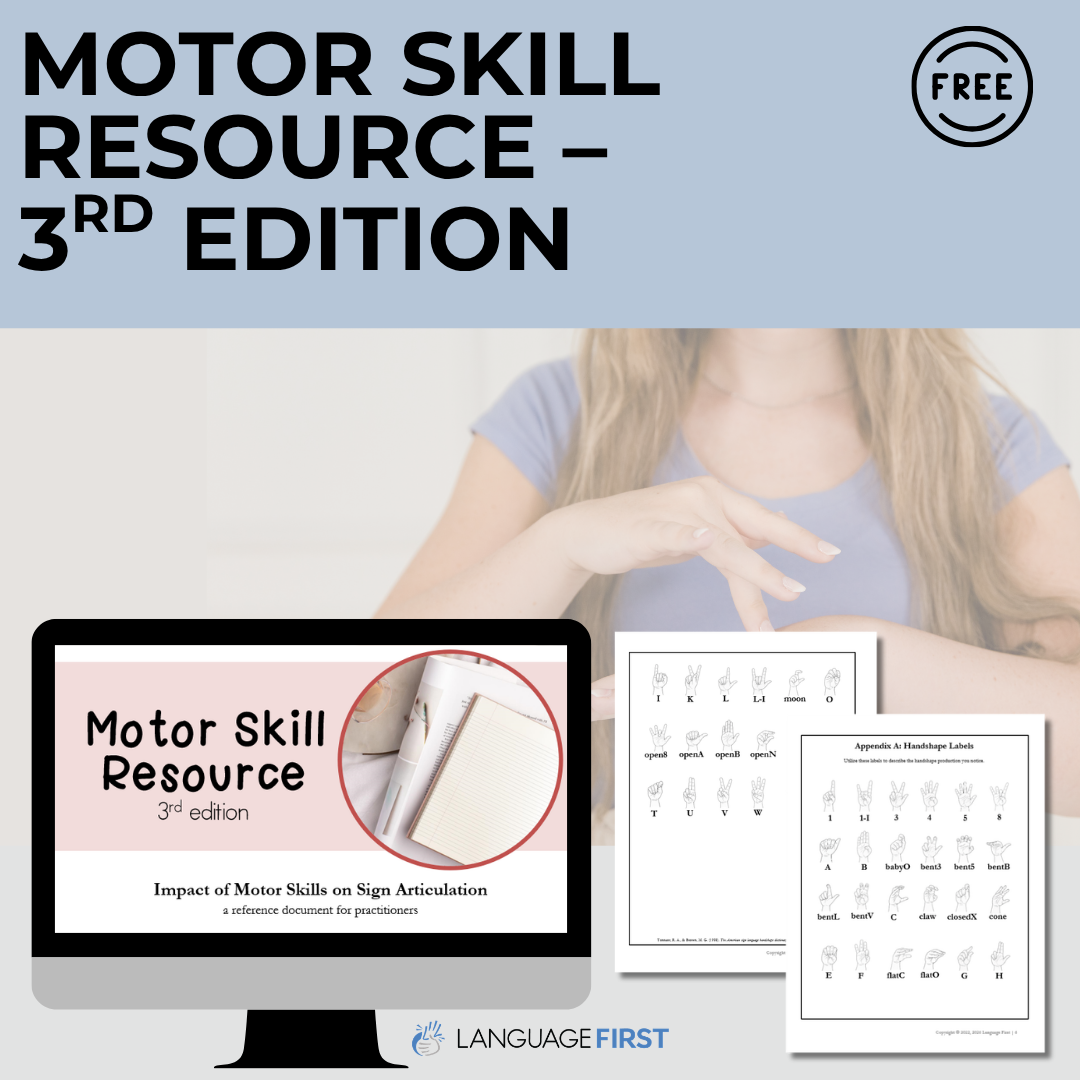
Use this resource to help document articulatory errors in American Sign Language. The creation of this document was a collaborative effort by a deaf linguist, a hearing (signing) speech-language pathologist, and a hearing (signing) occupational therapist.
With this document, practitioners will be able to:
Identify which articulators are implicated
Hands, arms, wrist, fingers, torso, and face/head
Determine which component of articulation is affected
Handshape formation
Place of articulation
Path movement
Describe the articulation error in a standardized way
Use language that can be understood across disciplines (Appendix E)
Note: Production errors can be linguistic-based (phonological) or motor-based (articulatory); this document focuses on motor-based articulation errors in ASL.
Informal Assessment for Language Deprivation
This informal assessment is designed for Deaf children with incomplete first language acquisition due to language deprivation. It helps practitioners gather information about the child’s expressive abilities at both the single-word and short-sentence levels, as well as identify any errors in their productions. The assessment includes 150 vocabulary items (30 animals, 30 food, 30 objects, 30 people, and 30 verbs) and 20 syntax items (10 SV and 10 SVO structures).
Includes:
Electronic stimuli
A fillable PDF for data collection
Additional data sheets to document phonological, semantic, morphological, and articulatory errors noted
Sample student data
Sample write-up for your report
Instructional video in ASL and English on how to use the assessment
High contrast stimuli for low vision students
Cartoon stimuli
Note: We strongly recommend providers who are not fluent in ASL co-administer and co-analyze this assessment with a native ASL speaker.

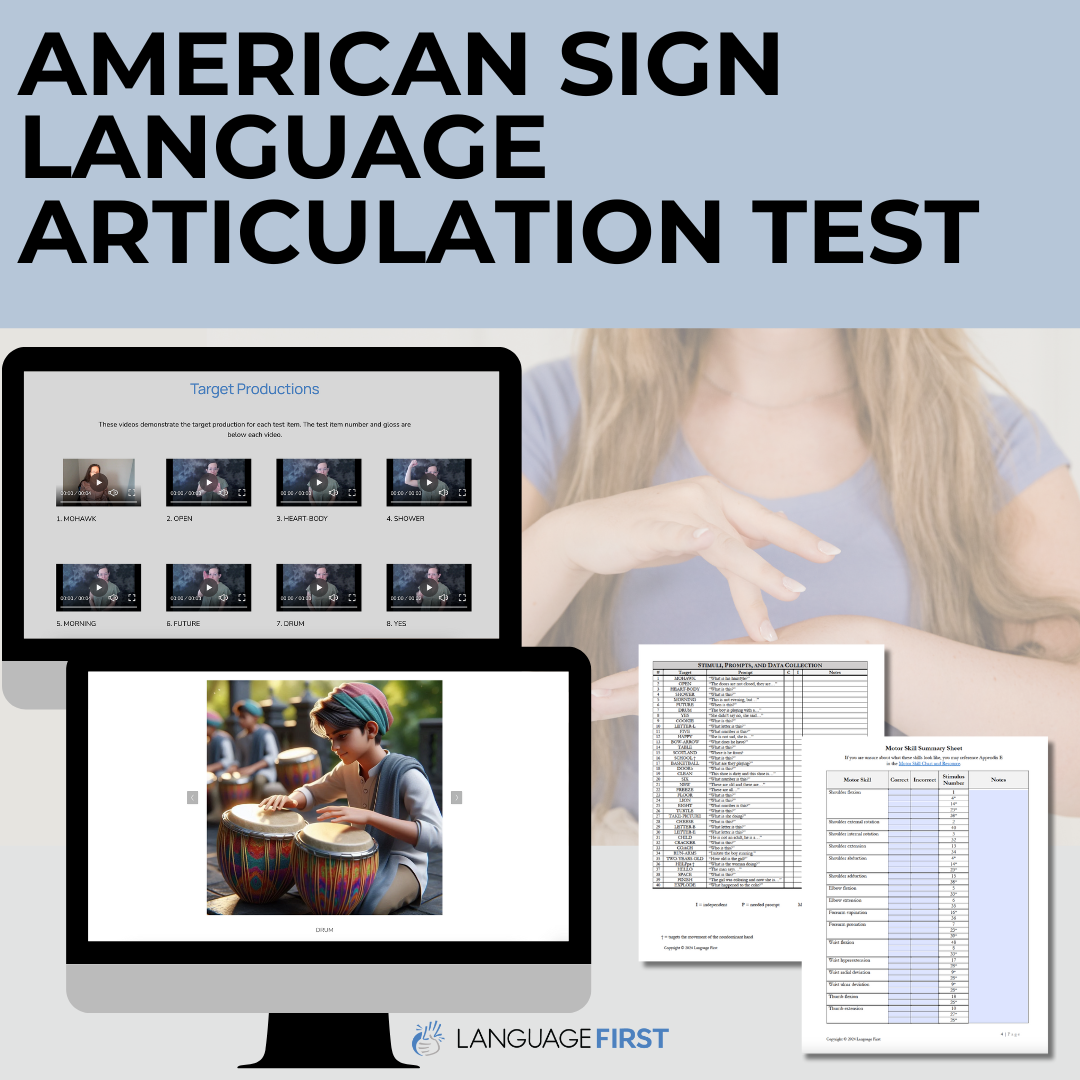
American Sign Language Articulation Test (ASL-AT)
This informal assessment is intended to gather information about how a Deaf child articulates words in American Sign Language (ASL). Because this is an articulation test and not a language test, the practitioner may prompt the student to elicit the target word, or simply model the target word and ask the student to copy it. The test contains digital stimuli, printable and digital data collection sheets, and embedded videos of a Deaf model signing the target stimuli.
The assessment also contains a summary sheet that is intended to help identify which motor skills the student struggled with. The practitioner takes the data recorded during the assessment and inputs it into the summary sheet. Then, trends or patterns in the student’s errors may become clear. For example, you may notice that the student incorrectly signed all the stimulus words that required elbow flexion.