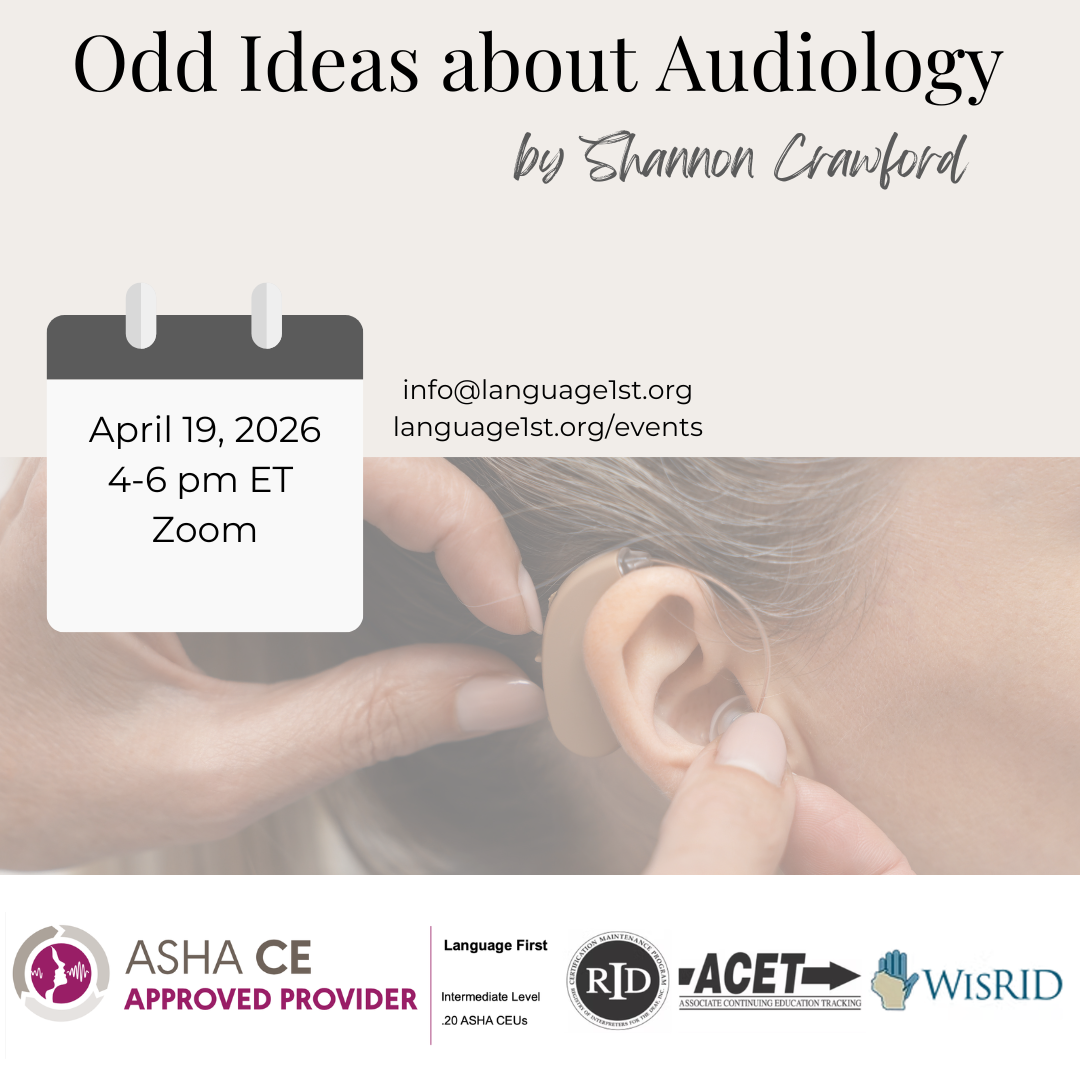
This webinar will be hosted via Zoom for national and international attendees on Sunday, April 19, 2026 from 4:00 - 6:00 pm ET.
Speaker Disclosures:
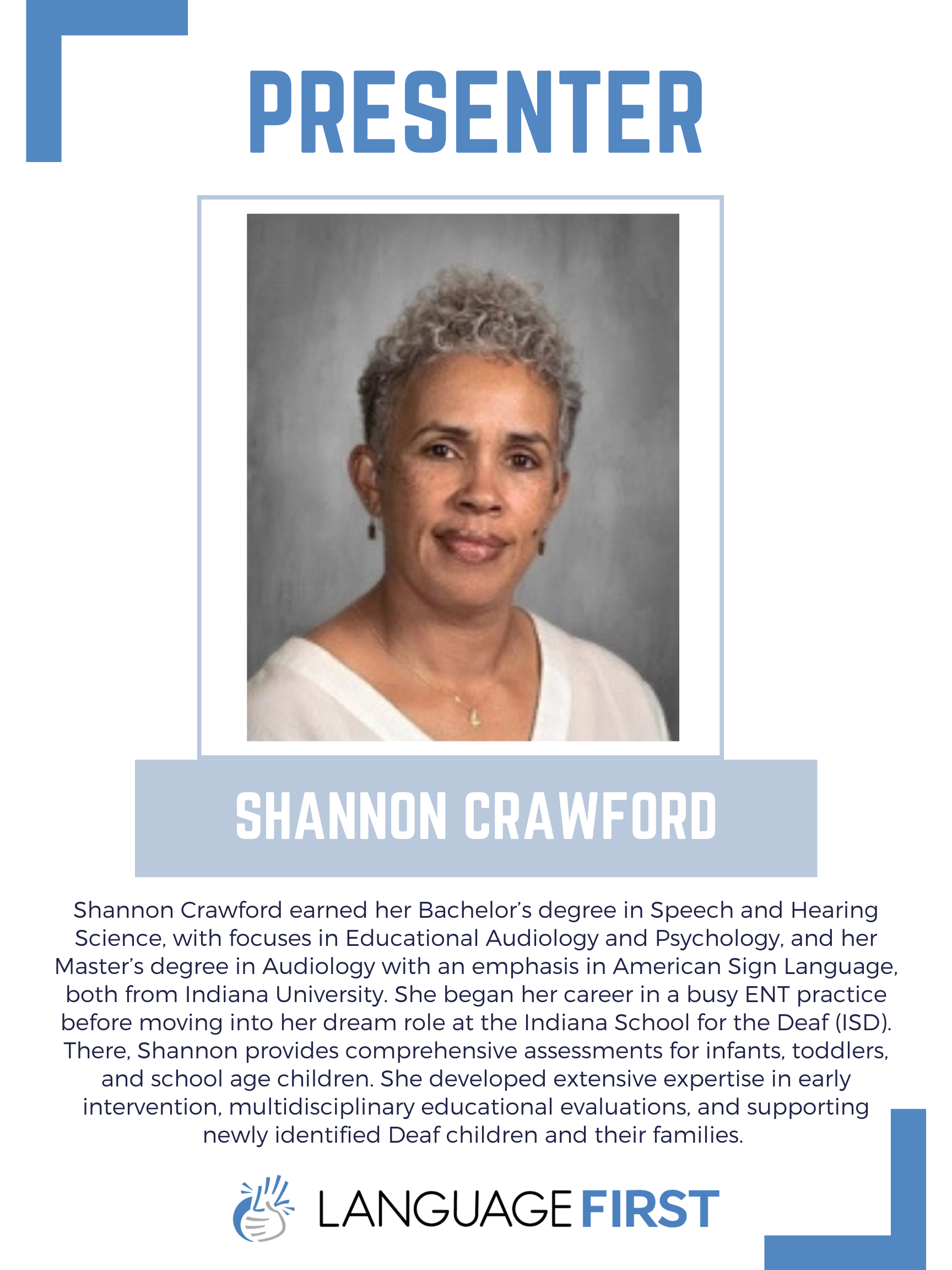
Financial disclosures: Shannon is receiving payment from Language First for presenting.
Nonfinancial disclosures: Shannon has no relevant nonfinancial disclosures.
Course Description:
This session invites attendees to radically reframe traditional audiology by shifting the focus from optimizing sound through technology to prioritizing access to visual language—particularly American Sign Language (ASL). Participants will explore how long‑standing beliefs and values within the field can directly influence the experiences and outcomes of Deaf children and their families. Together, we will examine the historical origins of audiology, a field initially designed around the needs of adults, and discuss how these frameworks can inadvertently limit language development for children. The session will highlight the importance of understanding each Deaf child as an individual learner rather than relying solely on research trends, standardized data, or outcomes rooted in auditory performance. Through guided reflection, discussion, and case-based scenarios, attendees will evaluate their own assumptions and consider new vantage points—especially those centered on the child’s lived experience. The goal is to inspire professionals to reimagine their role, expand their perspective, and embrace practices that support Deaf children in thriving, not merely surviving. Participants will leave this session with renewed purpose, a broader understanding of language access, and actionable ways to change the narrative within their own work.
Agenda
4:00-4:30: Historical origins of audiology
4:30-5:00: The impact on deaf children
5:00-5:30: Reimagining the role of the audiologist
5:30-5:45: How audiologists can promote equitable language access
5:45-6:00: Discussion, Q&A
Learner Outcomes:
Participants will be able to:
Identify common assumptions within audiology that may influence family decision‑making and coaching
Apply the ideas presented in the session to reframe interactions in ways that support visual language access, specifically ASL
Commit to at least one actionable change in your own work that promotes equitable language access
Registration information:
This is a digital purchase only; no physical ticket is provided. A form will populate for you to complete your registration and then your purchase will be added to your cart in the upper right-hand corner of the screen. You will receive an email with instructions on how to participate as well as a Google Calendar invite with the Zoom link one week prior to the event. Registration ends one day prior to the webinar. All registrants will receive a copy of the presenter’s PowerPoint and the presentation recording. Please email info@language1st.org with any questions.
This webinar will be hosted via Zoom for national and international attendees on Sunday, April 19, 2026 from 4:00 - 6:00 pm ET.
Speaker Disclosures:
Financial disclosures: Shannon is receiving payment from Language First for presenting.
Nonfinancial disclosures: Shannon has no relevant nonfinancial disclosures.
Course Description:
This session invites attendees to radically reframe traditional audiology by shifting the focus from optimizing sound through technology to prioritizing access to visual language—particularly American Sign Language (ASL). Participants will explore how long‑standing beliefs and values within the field can directly influence the experiences and outcomes of Deaf children and their families. Together, we will examine the historical origins of audiology, a field initially designed around the needs of adults, and discuss how these frameworks can inadvertently limit language development for children. The session will highlight the importance of understanding each Deaf child as an individual learner rather than relying solely on research trends, standardized data, or outcomes rooted in auditory performance. Through guided reflection, discussion, and case-based scenarios, attendees will evaluate their own assumptions and consider new vantage points—especially those centered on the child’s lived experience. The goal is to inspire professionals to reimagine their role, expand their perspective, and embrace practices that support Deaf children in thriving, not merely surviving. Participants will leave this session with renewed purpose, a broader understanding of language access, and actionable ways to change the narrative within their own work.
Agenda
4:00-4:30: Historical origins of audiology
4:30-5:00: The impact on deaf children
5:00-5:30: Reimagining the role of the audiologist
5:30-5:45: How audiologists can promote equitable language access
5:45-6:00: Discussion, Q&A
Learner Outcomes:
Participants will be able to:
Identify common assumptions within audiology that may influence family decision‑making and coaching
Apply the ideas presented in the session to reframe interactions in ways that support visual language access, specifically ASL
Commit to at least one actionable change in your own work that promotes equitable language access
Registration information:
This is a digital purchase only; no physical ticket is provided. A form will populate for you to complete your registration and then your purchase will be added to your cart in the upper right-hand corner of the screen. You will receive an email with instructions on how to participate as well as a Google Calendar invite with the Zoom link one week prior to the event. Registration ends one day prior to the webinar. All registrants will receive a copy of the presenter’s PowerPoint and the presentation recording. Please email info@language1st.org with any questions.