This webinar will be hosted via Zoom for national and international attendees on Sunday, April 26, 2026 from 9:00 - 11:00 am ET.
Speaker Disclosures:
Financial disclosures: The presenters are receiving payment from Language First for presenting.
Nonfinancial disclosures: The presenters have no relevant nonfinancial disclosures.
Course Description:
This presentation outlines current knowledge and classroom practice around fingerspelling in sign bilingual education and draws on ongoing action research from the Swedish ReadSign project. After a brief introduction and a review of reading research for deaf children, we define fingerspelling and summarize research linking it to reading. We then present a new bilingual teaching material, an adapted Swedish Sign Language/Swedish version of the ASL–English program Fingerspelling Our Way to Reading, developed for first‑level students (age 6) to strengthen phonological awareness, expressive and receptive fingerspelling, and printed‑word recognition. ReadSign (2023–2026) is a practice‑based project funded by the Swedish Institute for Educational Research, involving researchers from Stockholm University and three deaf schools, governed by the National Agency for Special Needs Education. Using a three‑cycle action‑research design and methods including classroom observations, log notes, and teacher interviews, we are examining the use of fingerspelling in the classroom to support deaf students’ early reading development and how teachers and students interact. We present ReadSign’s aims, methods, and key results, share practical examples of conducting action research with teachers, and discuss challenges and best practices. The session closes with summary takeaways and Q&A.
Agenda
9:00-9:15: Background - reading research on deaf children
9:15-9:25: What is fingerspelling?
9:25-9:45: Overview of research on fingerspelling and reading
9:45-10:10: Presentation of a Swedish bilingual teaching material based on fingerspelling
10:10-10:40: Presentation of the ReadSign project (aims, methods, results)
10:40-10:45: Summary and take-home messages
10:45-11:00: Q&A
Learner Outcomes:
Participants will be able to:
Describe key research findings on the role of fingerspelling in early reading development for deaf children
Define fingerspelling and its functions
Identify effective classroom practices and common challenges when using fingerspelling to support early literacy
Registration information:
This is a digital purchase only; no physical ticket is provided. A form will populate for you to complete your registration and then your purchase will be added to your cart in the upper right-hand corner of the screen. You will receive an email with instructions on how to participate as well as a Google Calendar invite with the Zoom link one week prior to the event. Registration ends one day prior to the webinar. All registrants will receive a copy of the presenter’s PowerPoint and the presentation recording. Please email info@language1st.org with any questions.
This webinar will be hosted via Zoom for national and international attendees on Sunday, April 26, 2026 from 9:00 - 11:00 am ET.
Speaker Disclosures:
Financial disclosures: The presenters are receiving payment from Language First for presenting.
Nonfinancial disclosures: The presenters have no relevant nonfinancial disclosures.
Course Description:
This presentation outlines current knowledge and classroom practice around fingerspelling in sign bilingual education and draws on ongoing action research from the Swedish ReadSign project. After a brief introduction and a review of reading research for deaf children, we define fingerspelling and summarize research linking it to reading. We then present a new bilingual teaching material, an adapted Swedish Sign Language/Swedish version of the ASL–English program Fingerspelling Our Way to Reading, developed for first‑level students (age 6) to strengthen phonological awareness, expressive and receptive fingerspelling, and printed‑word recognition. ReadSign (2023–2026) is a practice‑based project funded by the Swedish Institute for Educational Research, involving researchers from Stockholm University and three deaf schools, governed by the National Agency for Special Needs Education. Using a three‑cycle action‑research design and methods including classroom observations, log notes, and teacher interviews, we are examining the use of fingerspelling in the classroom to support deaf students’ early reading development and how teachers and students interact. We present ReadSign’s aims, methods, and key results, share practical examples of conducting action research with teachers, and discuss challenges and best practices. The session closes with summary takeaways and Q&A.
Agenda
9:00-9:15: Background - reading research on deaf children
9:15-9:25: What is fingerspelling?
9:25-9:45: Overview of research on fingerspelling and reading
9:45-10:10: Presentation of a Swedish bilingual teaching material based on fingerspelling
10:10-10:40: Presentation of the ReadSign project (aims, methods, results)
10:40-10:45: Summary and take-home messages
10:45-11:00: Q&A
Learner Outcomes:
Participants will be able to:
Describe key research findings on the role of fingerspelling in early reading development for deaf children
Define fingerspelling and its functions
Identify effective classroom practices and common challenges when using fingerspelling to support early literacy
Registration information:
This is a digital purchase only; no physical ticket is provided. A form will populate for you to complete your registration and then your purchase will be added to your cart in the upper right-hand corner of the screen. You will receive an email with instructions on how to participate as well as a Google Calendar invite with the Zoom link one week prior to the event. Registration ends one day prior to the webinar. All registrants will receive a copy of the presenter’s PowerPoint and the presentation recording. Please email info@language1st.org with any questions.

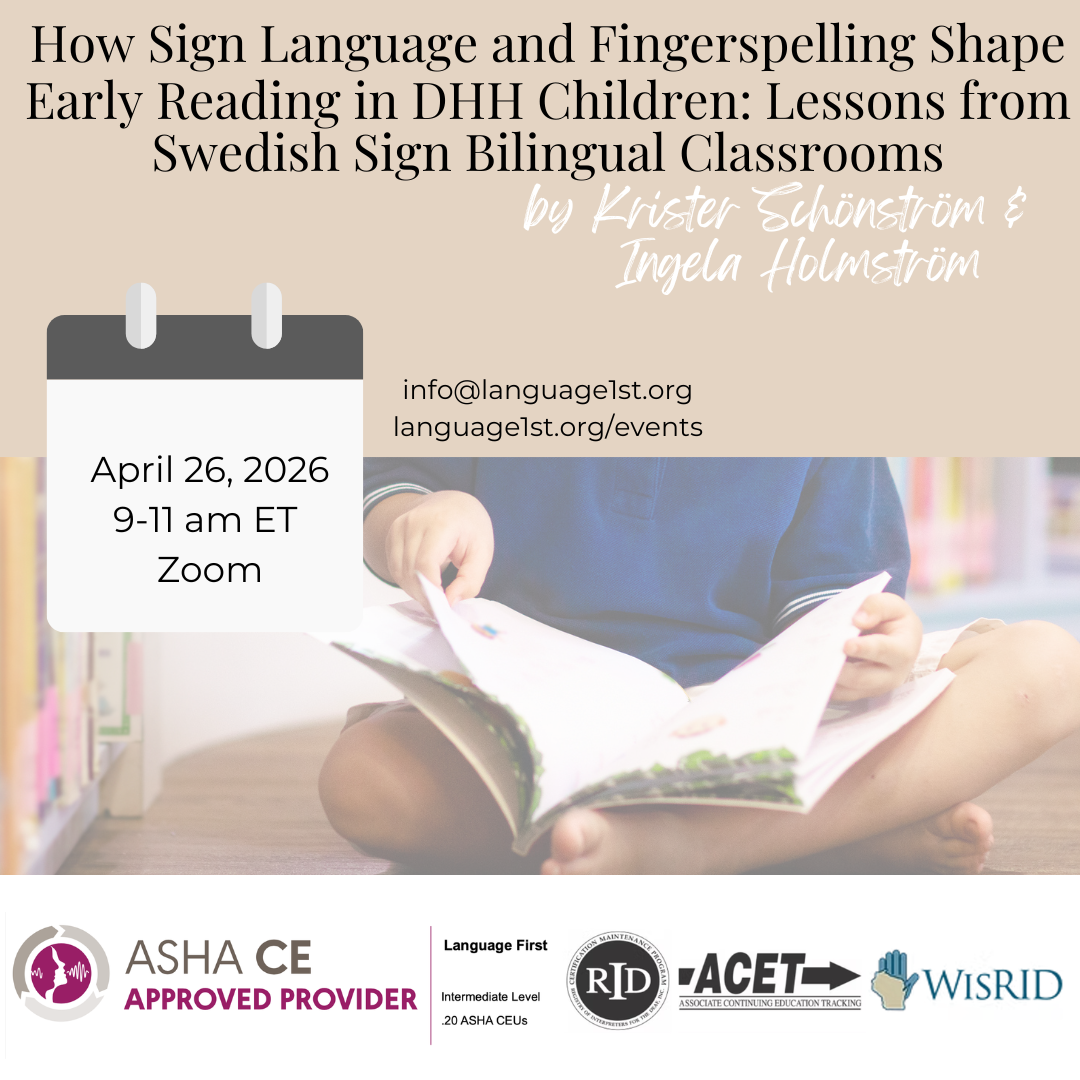 Image 1 of 3
 Image 2 of 3
 Image 3 of 3
